 The Nexus Archive
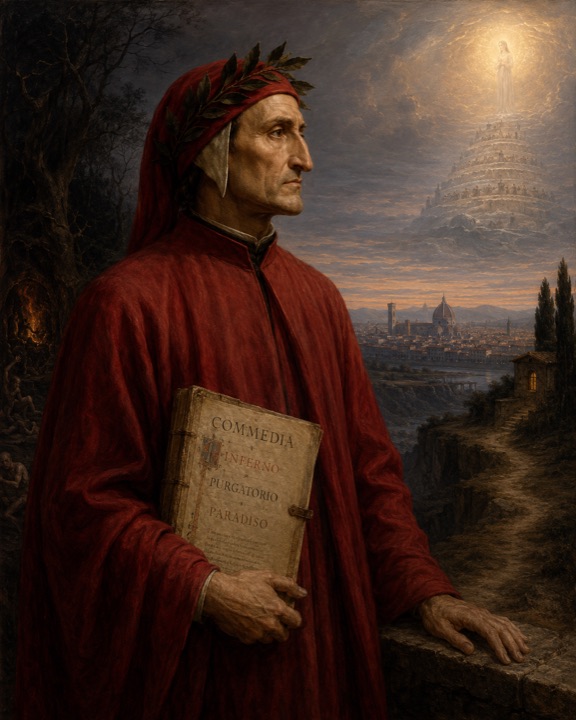
Christian Epic · Epic
The Divine Comedy
by Dante · The Pilgrim of Judgment · Medieval Italy, 1265-1321
Dante's complete journey through Inferno, Purgatorio, and Paradiso: sin, judgment, purification, exile, love, and the final vision of God.
- Brutal
- c. 1308-1321
- ~8 hr read
- 100 chapter guides
- Public domain
Start reading · Read the Inferno guide free
Before the text
Editor's Prelude
Downward, Upward, Homeward
Prepared by the Nexus Editors
A familiar life can become a dark wood. Dante begins there, unable to find his way out. His journey makes that private crisis a question about everyone: how do people become trapped by what they love, and how can they learn to love differently?
Dante wrote in exile from Florence. The city’s rivalries follow him into a Christian afterlife crowded with friends, enemies, teachers, rulers, and poets. Affection and judgment keep colliding. A voice can move him to tears even when the life it describes has gone terribly wrong. His own pity, anger, and pride also come under pressure.
The poem moves through Hell, Purgatory, and Heaven in one hundred cantos. A canto is a short division of a long poem. Henry Wadsworth Longfellow’s English keeps the verse in groups of three lines. Ancient myths, Christian teaching, and Florentine quarrels share this world. Guides explain its order, but Dante must do more than understand their words. His sight and desires must change before he can make his way home.
The opening pages
Inferno: Canto I
Midway upon the journey of our life
I found myself within a forest dark,
For the straightforward pathway had been lost.
Ah me! how hard a thing it is to say
What was this forest savage, rough, and stern,
Which in the very thought renews the fear.
So bitter is it, death is little more;
But of the good to treat, which there I found,
Speak will I of the other things I saw there.
I cannot well repeat how there I entered,
So full was I of slumber at the moment
In which I had abandoned the true way.
But after I had reached a mountain’s foot,
At that point where the valley terminated,
Which had with consternation pierced my heart,
Upward I looked, and I beheld its shoulders,
Vested already with that planet’s rays
Which leadeth others right by every road.
Then was the fear a little quieted
That in my heart’s lake had endured throughout
The night, which I had passed so piteously.
And even as he, who, with distressful breath,
Forth issued from the sea upon the shore,
Turns to the water perilous and gazes;
So did my soul, that still was fleeing onward,
Turn itself back to re-behold the pass
Which never yet a living person left.
After my weary body I had rested,
The way resumed I on the desert slope,
So that the firm foot ever was the lower.
And lo! almost where the ascent began,
A panther light and swift exceedingly,
Which with a spotted skin was covered o’er!
And never moved she from before my face,
Nay, rather did impede so much my way,
That many times I to return had turned.
The time was the beginning of the morning,
And up the sun was mounting with those stars
That with him were, what time the Love Divine
At first in motion set those beauteous things;
So were to me occasion of good hope,
The variegated skin of that wild beast,
The hour of time, and the delicious season;
But not so much, that did not give me fear
A lion’s aspect which appeared to me.
He seemed as if against me he were coming
With head uplifted, and with ravenous hunger,
So that it seemed the air was afraid of him;
And a she-wolf, that with all hungerings
Seemed to be laden in her meagreness,
And many folk has caused to live forlorn!
Read it in a Quest
Follow epic beyond Homer through Virgil's Roman exile, Dante's journey through judgment, and Milton's cosmic drama of rebellion and fall.
Chapter guides · 100
Inferno: Canto I
Inferno: Canto I
Dante cannot escape the dark wood by the road he first chooses.
What happens
Dante finds himself lost halfway through life. A sunlit hill seems to offer safety, but a panther, a lion, and a she-wolf block his climb. Virgil, the ancient Roman poet Dante admires, appears and offers a different route. It passes through the dead before reaching a place where a higher guide can take over.
Where it ends
Dante asks Virgil to lead him. Virgil sets out, and Dante follows.
Inferno: Canto II
Inferno: Canto II
Help reaches Dante through a chain of people who care about his danger.
What happens
As evening falls, Dante doubts that he deserves a journey made by figures such as Aeneas and Saint Paul. Virgil explains why he came. Beatrice left Heaven to ask for his help after Lucia alerted her to Dante’s peril. Their concern began with another merciful lady in Heaven. Beatrice’s message gives Dante courage to trust the journey.
Where it ends
Dante accepts Virgil as his guide, and they enter the difficult way together.
Inferno: Canto III
Inferno: Canto III
Hell begins with people who refused to commit themselves to either good or evil.
Inferno: Canto IV
Inferno: Canto IV
Dante’s admiration for ancient greatness meets the poem’s harsh limit on salvation.
Inferno: Canto V
Inferno: Canto V
Francesca’s moving account of desire tests Dante’s response to the punished.
Inferno: Canto VI
Inferno: Canto VI
Private appetite gives way to a bitter account of Florence’s public life.
Inferno: Canto VII
Inferno: Canto VII
Grasping at wealth and wasting it appear as two forms of the same disorder.
Inferno: Canto VIII
Inferno: Canto VIII
The descent reaches a city whose defenders openly resist the travelers.
Inferno: Canto IX
Inferno: Canto IX
Heavenly authority opens the gate that Virgil cannot open alone.
Inferno: Canto X
Inferno: Canto X
Family feeling and political pride survive inside the burning tombs.
Inferno: Canto XI
Inferno: Canto XI
Virgil explains why the deepest parts of Hell punish damage to trust.
Inferno: Canto XII
Inferno: Canto XII
Violence against other people is measured out in a river of boiling blood.
Inferno: Canto XIII
Inferno: Canto XIII
The wood makes Dante confront lives turned against their own bodies.
Inferno: Canto XIV
Inferno: Canto XIV
Capaneus keeps his defiance alive even under a rain of fire.
Inferno: Canto XV
Inferno: Canto XV
Respect for an old teacher remains strong inside a scene of punishment.
Inferno: Canto XVI
Inferno: Canto XVI
Three Florentines make the loss of civic character a personal question.
Inferno: Canto XVII
Inferno: Canto XVII
Fraud has a trustworthy face and a dangerous body.
Inferno: Canto XVIII
Inferno: Canto XVIII
The first ditches of fraud punish people who exploit others through desire and speech.
Inferno: Canto XIX
Inferno: Canto XIX
Dante attacks the sale of sacred office as a betrayal of the Church’s purpose.
Inferno: Canto XX
Inferno: Canto XX
Those who tried to see too far ahead must now look behind them.
Inferno: Canto XXI
Inferno: Canto XXI
A promise of safe guidance leaves Dante surrounded by reasons for distrust.
Inferno: Canto XXII
Inferno: Canto XXII
The demons’ appetite for torment makes their own plan collapse.
Inferno: Canto XXIII
Inferno: Canto XXIII
The appearance of virtue becomes a heavy covering for hypocrisy.
Inferno: Canto XXIV
Inferno: Canto XXIV
The thieves cannot keep even their own bodies secure.
Inferno: Canto XXV
Inferno: Canto XXV
The theft of property becomes a terrifying theft of bodily identity.
Inferno: Canto XXVI
Inferno: Canto XXVI
Ulysses turns the desire for knowledge into a voyage beyond every accepted limit.
Inferno: Canto XXVII
Inferno: Canto XXVII
Guido’s story exposes the false promise of forgiveness without repentance.
Inferno: Canto XXVIII
Inferno: Canto XXVIII
The makers of division carry that division in their wounded bodies.
Inferno: Canto XXIX
Inferno: Canto XXIX
Dante’s concern for an injured family honor gives way to the sickness of falsifiers.
Inferno: Canto XXX
Inferno: Canto XXX
False identities, false money, and false testimony end in a degrading quarrel.
Inferno: Canto XXXI
Inferno: Canto XXXI
What first look like towers prove to be giants around the final pit.
Inferno: Canto XXXII
Inferno: Canto XXXII
Betrayal leaves the deepest bonds of human life frozen and brutal.
Inferno: Canto XXXIII
Inferno: Canto XXXIII
Ugolino’s grief makes political hatred inseparable from the suffering of children.
Inferno: Canto XXXIV
Inferno: Canto XXXIV
Escape begins when the travelers turn at the very bottom of the world.
Purgatorio: Canto I
Purgatorio: Canto I
The new shore offers cleansing and hope after Hell’s fixed punishments.
Purgatorio: Canto II
Purgatorio: Canto II
Even beautiful friendship can become a delay when a harder duty calls.
Purgatorio: Canto III
Purgatorio: Canto III
Manfredi’s story places divine mercy beyond the reach of a Church sentence.
Purgatorio: Canto IV
Purgatorio: Canto IV
A difficult climb leads to a waiting soul whose familiar habits still show.
Purgatorio: Canto V
Purgatorio: Canto V
A final movement toward God changes the fate of people who died by violence.
Purgatorio: Canto VI
Purgatorio: Canto VI
A small act of local affection becomes a rebuke to a divided Italy.
Purgatorio: Canto VII
Purgatorio: Canto VII
The valley of rulers measures public rank against neglected responsibility.
Purgatorio: Canto VIII
Purgatorio: Canto VIII
Protection and mutual prayer replace the self-reliance of earthly power.
Purgatorio: Canto IX
Purgatorio: Canto IX
Entry into Purgatory requires humility and an authority beyond Dante’s own strength.
Purgatorio: Canto X
Purgatorio: Canto X
The first terrace teaches humility through images before it presents the proud.
Purgatorio: Canto XI
Purgatorio: Canto XI
The proud learn that family rank and artistic fame cannot make a lasting self.
Purgatorio: Canto XII
Purgatorio: Canto XII
Dante’s first burden lifts as he leaves the terrace of pride.
Purgatorio: Canto XIII
Purgatorio: Canto XIII
The envious must learn to depend on the neighbors whose happiness once hurt them.
Purgatorio: Canto XIV
Purgatorio: Canto XIV
Envy turns a discussion of home into grief over a whole region’s decline.
Purgatorio: Canto XV
Purgatorio: Canto XV
Shared spiritual good grows through sharing instead of shrinking.
Purgatorio: Canto XVI
Purgatorio: Canto XVI
Marco places responsibility for moral failure in human choice and failed leadership.
Purgatorio: Canto XVII
Purgatorio: Canto XVII
Virgil explains sin as love aimed wrongly, too weakly, or too strongly.
Purgatorio: Canto XVIII
Purgatorio: Canto XVIII
An impulse toward something attractive becomes a moral choice only through consent.
Purgatorio: Canto XIX
Purgatorio: Canto XIX
A pleasing appearance can hide corruption, and high office cannot satisfy the soul.
Purgatorio: Canto XX
Purgatorio: Canto XX
Hugh Capet traces the harm done when a ruling family treats power as an appetite.
Purgatorio: Canto XXI
Purgatorio: Canto XXI
The mountain shakes when a cleansed soul freely desires to rise.
Purgatorio: Canto XXII
Purgatorio: Canto XXII
Statius credits Virgil with helping others reach a truth he did not reach himself.
Purgatorio: Canto XXIII
Purgatorio: Canto XXIII
The hungry souls’ longing is painful, yet they welcome it as healing.
Purgatorio: Canto XXIV
Purgatorio: Canto XXIV
The discussion of a new poetic style unfolds among souls who must keep moving.
Purgatorio: Canto XXV
Purgatorio: Canto XXV
Statius explains how a bodiless soul can still appear hungry and suffer.
Purgatorio: Canto XXVI
Purgatorio: Canto XXVI
Poets meet as fellow souls whose love and language need purification.
Purgatorio: Canto XXVII
Purgatorio: Canto XXVII
Dante must pass through the fire before he can exercise a healed freedom.
Purgatorio: Canto XXVIII
Purgatorio: Canto XXVIII
The garden presents nature freed from the damage and uncertainty of earthly life.
Purgatorio: Canto XXIX
Purgatorio: Canto XXIX
A solemn procession turns the garden into a moving vision of sacred history.
Purgatorio: Canto XXX
Purgatorio: Canto XXX
Beatrice’s arrival makes Dante face the life from which he needs to turn.
Purgatorio: Canto XXXI
Purgatorio: Canto XXXI
Confession allows Dante to pass from shame toward a clearer vision of Beatrice.
Purgatorio: Canto XXXII
Purgatorio: Canto XXXII
The chariot’s violent transformation shows a sacred institution exposed to corruption.
Purgatorio: Canto XXXIII
Purgatorio: Canto XXXIII
Dante leaves the mountain renewed in both memory and desire.
Paradiso: Canto I
Paradiso: Canto I
Beatrice explains Dante’s ascent as the natural motion of a purified desire.
Paradiso: Canto II
Paradiso: Canto II
The moon becomes an occasion to question explanations based only on appearances.
Paradiso: Canto III
Paradiso: Canto III
Piccarda describes peace as wanting what divine love wills.
Paradiso: Canto IV
Paradiso: Canto IV
The souls’ appearances teach through the senses, while their true home is shared.
Paradiso: Canto V
Paradiso: Canto V
A vow gives away something precious, so neither breaking nor changing it is a small matter.
Paradiso: Canto VI
Paradiso: Canto VI
Justinian places public justice above the private use of imperial power.
Paradiso: Canto VII
Paradiso: Canto VII
Beatrice connects the mystery of redemption with the restoration of human dignity.
Paradiso: Canto VIII
Paradiso: Canto VIII
A good society needs different gifts and people fitted to the work they do.
Paradiso: Canto IX
Paradiso: Canto IX
Heaven’s joy can transform a history of desire without approving its former faults.
Paradiso: Canto X
Paradiso: Canto X
The heaven of wisdom welcomes Dante through shared praise and generous teaching.
Paradiso: Canto XI
Paradiso: Canto XI
Thomas praises another order’s founder before judging the failures of his own.
Paradiso: Canto XII
Paradiso: Canto XII
Bonaventura answers Thomas’s generosity with praise across the same dividing line.
Paradiso: Canto XIII
Paradiso: Canto XIII
A claim about unmatched wisdom needs a careful limit before it can be understood.
Paradiso: Canto XIV
Paradiso: Canto XIV
Heavenly fulfillment includes the body and the human bonds connected with it.
Paradiso: Canto XV
Paradiso: Canto XV
Cacciaguida turns heavenly welcome into a conversation about family and civic life.
Paradiso: Canto XVI
Paradiso: Canto XVI
Pride in an honored ancestry meets a reminder that families and cities can decline.
Paradiso: Canto XVII
Paradiso: Canto XVII
Dante receives a public duty from the suffering he will endure as an exile.
Paradiso: Canto XVIII
Paradiso: Canto XVIII
The next heaven makes justice a visible demand upon those who govern.
Paradiso: Canto XIX
Paradiso: Canto XIX
The eagle confronts the limits of human judgment about divine justice.
Paradiso: Canto XX
Paradiso: Canto XX
The eagle’s surprising examples warn against deciding in advance whom God can save.
Paradiso: Canto XXI
Paradiso: Canto XXI
A question about divine choice reaches a limit even a blessed spirit cannot cross.
Paradiso: Canto XXII
Paradiso: Canto XXII
The height of the journey makes earthly pride appear small.
Paradiso: Canto XXIII
Paradiso: Canto XXIII
Dante’s sight grows stronger through a vision he still cannot fully remember or describe.
Paradiso: Canto XXIV
Paradiso: Canto XXIV
Peter asks Dante to make his faith clear through both definition and personal conviction.
Paradiso: Canto XXV
Paradiso: Canto XXV
Hope looks toward complete life with God, including the restoration of the body.
Paradiso: Canto XXVI
Paradiso: Canto XXVI
Love of God gives order to Dante’s love for everything else.
Paradiso: Canto XXVII
Paradiso: Canto XXVII
Peter’s anger makes the duty to speak about corruption part of Dante’s heavenly education.
Paradiso: Canto XXVIII
Paradiso: Canto XXVIII
The angels’ order is measured by spiritual power rather than physical size.
Paradiso: Canto XXIX
Paradiso: Canto XXIX
Beatrice contrasts continuous attention to God with the distractions of false teaching.
Paradiso: Canto XXX
Paradiso: Canto XXX
Dante’s new sight reveals the heavenly community behind its first symbolic appearance.
Paradiso: Canto XXXI
Paradiso: Canto XXXI
Beatrice’s guidance reaches its fulfillment as Bernard prepares Dante for the final vision.
Paradiso: Canto XXXII
Paradiso: Canto XXXII
Bernard explains the rose as a community ordered by faith and grace.
Paradiso: Canto XXXIII
Paradiso: Canto XXXIII
The final vision brings Dante’s desire and will into harmony with divine love.
Questions readers ask
- How long does it take to read The Divine Comedy?
- About 8 hr in total.
- How difficult is The Divine Comedy?
- Brutal. A long epic; about 8 hours of reading.
- Which translation is this?
- The Henry Wadsworth Longfellow translation from the Italian. The text follows Project Gutenberg Longfellow Divine Comedy text witnesses.
- Can I read The Divine Comedy for free?
- The Divine Comedy is part of Nexus Premium, so reading it needs an account and a Premium subscription, and completing an earlier Quest's Mastery. The opening above and two chapter guides on this page are free to read.
- How many chapter guides are there?
- 100 chapter guides, written by the Nexus editors. Two open in full here; the rest show their opening line.
About Dante
Dante Alighieri was a Florentine poet and political exile whose Divine Comedy became one of the central works of world literature. The poem moves through Inferno, Purgatorio, and Paradiso, turning theology, politics, memory, and love into a visionary journey.
“What must the soul see before it can be healed?”
Dante gives Nexus the epic of moral vision: every life, city, sin, virtue, and longing is placed inside an ordered universe.
Source text: public domain. Chapter guides: original Nexus writing. The Divine Comedy is part of The Nexus Archive, guided Quests through the great works.