 The Nexus Archive
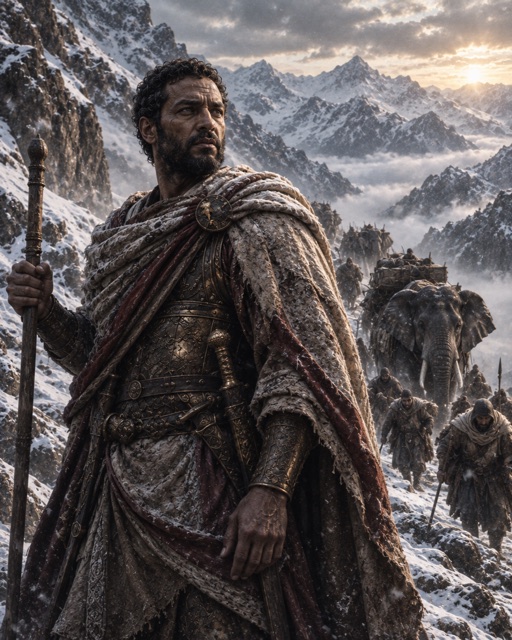
Carthaginian Command · Biography
Life of Hannibal
by Cornelius Nepos
Featuring Hannibal
Cornelius Nepos's compact ancient biography of Hannibal, in J. C. Rolfe's English translation.
- Beginner
- c. 1st c. BCE
- ~15 min read
- 2 chapter guides
- Public domain
Start reading · Read the The Oath and the Italian War guide free
Before the text
Editor's Prelude
The Enemy Rome Could Not Forget
A Roman writer begins this life by granting Rome’s enemy extraordinary skill. Nepos makes Hannibal’s superiority among commanders answer Roman superiority in courage. Admiration crosses the line between the two peoples without dissolving their hostility.
The biography moves quickly, choosing striking encounters and decisions rather than reconstructing every campaign. A commander’s character emerges through what he promises, notices and contrives. Stories told within the story also have their occasions: a remembered childhood oath can become an answer to present suspicion.
Hannibal’s greatness is inseparable here from a hatred he treats as an inheritance. That combination gives the portrait its uneasy force. Nepos asks how much one person’s intelligence and persistence can accomplish amid the loyalties, jealousies and resources of other people.
The opening pages
The Oath and the Italian War
Oath, Spain, and Command
Section 1
Hannibal the Carthaginian, son of Hamilcar. If it be true, as no one doubts, that the Roman people have surpassed all other nations in valour, it must be admitted that Hannibal excelled all other commanders in skill as much as the Roman people are superior to all nations in bravery. For as often as he engaged with that people in Italy, he invariably came off victor; and if his strength had not been impaired by the jealousy of his fellow-citizens at home, he would have been able, to all appearance, to conquer the Romans. But the disparagement of the multitude overcame the courage of one man.
Yet after all, he so cherished the hatred of the Romans which had, as it were, been left him as an inheritance by his father, that he would have given up his life rather than renounce it. Indeed, even after he had been driven from his native land and was dependent on the aid of foreigners, he never ceased to war with the Romans in spirit.
Section 2
For not to mention Philip, whom from afar he made an enemy of the Romans, he fired Antiochus, the most powerful of all kings in those times, with such a desire for war, that from far away on the Red Sea he made preparations to invade Italy.
To his court came envoys from Rome to sound his intentions and try by secret intrigues to arouse his suspicions of Hannibal, alleging that they had bribed him and that he had changed his sentiments. These attempts were not made in vain, and when Hannibal learned it and noticed that he was excluded from the king's more intimate councils, he went to Antiochus, as soon as the opportunity offered, and after calling to mind many proofs of his loyalty and his hatred of the Romans, he added: "My father Hamilcar, when I was a small boy not more than nine years old, just as he was setting out from Carthage to Spain as commander-in-chief, offered up victims to Jupiter, Greatest and Best of gods. While this ceremony was being performed, he asked me if I would like to go with him on the campaign. I eagerly accepted and began to beg him not to hesitate to take me with him. Thereupon he said: 'I will do it, provided you will give me the pledge that I ask.' With that he led me to the altar on which he had begun his sacrifice, and having dismissed all the others, he bade me lay hold of the altar and swear that I would never be a friend to the Romans. For my part, up to my present time of life, I have kept the oath which I swore to my father so faithfully, that no one ought to doubt that in the future I shall be of the same mind. Therefore, if you have any kindly intentions with regard to the Roman people, you will be wise to hide them from me; but when you prepare war, you will go counter to your own interests if you do not make me the leader in that enterprise."
Read it in a Quest
A study of command at the scale where brilliance, glory, and ruin begin to merge.
Chapter guides · 2
The Oath and the Italian War
Victory Is Not the Whole Life
Nepos turns famous campaigns into evidence about character, then lets defeat test the portrait.
A portrait built from selected deeds
Nepos opens by making Hannibal’s skill surpass that of other commanders as Roman bravery surpasses that of other peoples. The oath, Alpine crossing and cattle trick support a portrait of tenacity and invention. The childhood oath reaches us as a story Hannibal tells Antiochus to answer suspicions about his loyalty; Nepos has framed an act of recollection as well as an early event.
Defeat without surrender
Zama changes Hannibal’s position without changing his resolve. During his escape, Hannibal defeats a Numidian ambush, then rallies survivors and raises fresh troops at Hadrumetum. Nepos sets this renewed effort against Carthage’s exhausted resources. The translator’s notes qualify details of the narrative, including Hannibal’s age at his Spanish command and the interval after Zama.
Exile, Stratagem, and Death
Defeat Does Not End the Threat
Hannibal turns to public office, foreign kings and stratagems as Rome continues to pursue him.
Questions readers ask
- How long does it take to read Life of Hannibal?
- About 15 min in total.
- How difficult is Life of Hannibal?
- Beginner. A short biography; about 15 minutes of reading.
- Which translation is this?
- The J. C. Rolfe translation from the Latin. The text follows Cornelius Nepos, Life of Hannibal (J. C. Rolfe translation) (1929).
- Can I read Life of Hannibal for free?
- Life of Hannibal is part of Nexus Premium, so reading it needs an account and a Premium subscription, and completing an earlier Quest's Mastery. The opening above and one chapter guide on this page are free to read.
- How many chapter guides are there?
- 2 chapter guides, written by the Nexus editors. One opens in full here; the rest show their opening line.
About Hannibal
Hannibal Barca was the Carthaginian commander who carried the Second Punic War into Italy and inflicted some of Rome's greatest defeats. His full ancient-source dossier is coming soon.
“How far can tactical genius overcome strategic isolation?”
Hannibal remains one of history's defining studies in command, asymmetry, and the limits of battlefield brilliance.
Source text: public domain. Chapter guides: original Nexus writing. Life of Hannibal is part of The Nexus Archive, guided Quests through the great works.