 The Nexus Archive
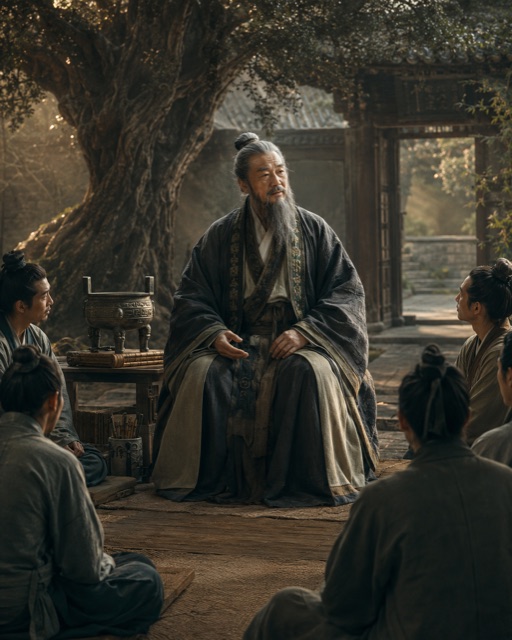
Confucianism · Formative text
The Great Learning and The Doctrine of the Mean
by Confucian canon
Featuring Confucius
Two short Confucian canon texts on cultivated character, family order, government, sincerity, and the steady path of the Mean.
- Intermediate
- c. 500-200 BCE
- ~45 min read
- 5 chapter guides
- Public domain
Start reading · Read the The Great Learning guide free
Before the text
Editor's Prelude
The Distance Between Knowledge and Character
How can a ruler expect order in a kingdom when he cannot govern his own desires or recognize his partiality toward his family? The Great Learning begins with that connection between private conduct and public power. The Doctrine of the Mean asks how human conduct belongs to a larger order of Heaven, nature, and society.
Both texts grew within the tradition associated with Confucius and were transmitted in the Records of Ritual. Tradition associates them with Zengzi and Zisi, Confucius's disciple and grandson respectively. They combine sayings attributed to the Master, citations of older poetry and history, and explanatory argument. Their speakers invoke ancient rulers as examples against which present conduct can be judged.
The Great Learning's short opening is followed by a commentary traditionally assigned to Zengzi, called Tsang in James Legge's translation. Its sequence runs from investigating things and becoming sincere to ordering a household and governing a state. The Doctrine of the Mean develops the demands of ordinary relationships, then makes ambitious claims about the sage's place in the transforming work of Heaven and Earth.
Legge's nineteenth-century terms need some care. The ‘Mean’ concerns fitting and sustained conduct, rather than splitting every difference. ‘Sincerity’ extends beyond truthful speech toward the full realization of one's nature. These classics make rulers answerable for the well-being of their people while retaining distinctions of rank, kinship, and ritual authority.
The opening pages
The Great Learning
WHAT THE GREAT LEARNING teaches, is to illustrate illustrious virtue; to renovate the people; and to rest in the highest excellence.
The point where to rest being known, the object of pursuit is then determined; and, that being determined, a calm unperturbedness may be attained to. To that calmness there will succeed a tranquil repose. In that repose there may be careful deliberation, and that deliberation will be followed by the attainment of the desired end.
Things have their root and their branches. Affairs have their end and their beginning. To know what is first and what is last will lead near to what is taught in the Great Learning.
The ancients who wished to illustrate illustrious virtue throughout the kingdom, first ordered well their own states. Wishing to order well their states, they first regulated their families. Wishing to regulate their families, they first cultivated their persons. Wishing to cultivate their persons, they first rectified their hearts. Wishing to rectify their hearts, they first sought to be sincere in their thoughts. Wishing to be sincere in their thoughts, they first extended to the utmost their knowledge. Such extension of knowledge lay in the investigation of things.
Things being investigated, knowledge became complete. Their knowledge being complete, their thoughts were sincere. Their thoughts being sincere, their hearts were then rectified. Their hearts being rectified, their persons were cultivated. Their persons being cultivated, their families were regulated. Their families being regulated, their states were rightly governed. Their states being rightly governed, the whole kingdom was made tranquil and happy.
From the Son of Heaven down to the mass of the people, all must consider the cultivation of the person the root of everything besides.
It cannot be, when the root is neglected, that what should spring from it will be well ordered. It never has been the case that what was of great importance has been slightly cared for, and, at the same time, that what was of slight importance has been greatly cared for.
COMMENTARY OF THE PHILOSOPHER TSANG
In the Announcement to K'ang, it is said, "He was able to make his virtue illustrious."
In the Tai Chia, it is said, "He contemplated and studied the illustrious decrees of Heaven."
In the Canon of the emperor (Yao), it is said, "He was able to make illustrious his lofty virtue."
These passages all show how those sovereigns made themselves illustrious.
Chapter guides · 5
The Great Learning
The Root Must Be Cultivated First
The Great Learning connects public order with knowledge, sincerity, and the cultivation of the person.
The root and its branches
The opening chain runs from investigating things and completing knowledge through sincerity, the heart, and the person to the family, state, and kingdom. It is also given in reverse: those who wished to make virtue shine through the kingdom began by ordering their states, then traced the requirements inward to the investigation of things. Cultivation of the person is called the root for everyone, from the Son of Heaven downward.
Partiality within the household
The translated commentary traditionally assigned to Tsang tests this sequence against self-deception, fear, anger, and family favoritism. Loving one's son can make his faults hard to see. The household therefore cannot be assumed to be well ordered merely because its head feels affection; judgment must survive that affection.
A ruler’s measure
The measuring-square passage applies reciprocity above, below, before, behind, and on either side. A ruler must share the people's loves and aversions rather than use them as instruments of private gain. The closing discussion makes virtue the root and wealth a result, warning that greed and jealous ministers can undo the order the ruler claims to establish.
The Doctrine of the Mean I–XVI: The Path and the Person
The Mean Has to Be Lived
Doctrine chapters I–XVI connect inward equilibrium with relationships, circumstances, and unseen spirits.
Nature, equilibrium, and harmony
What Heaven confers becomes nature; following that nature is the path, which instruction cultivates. The opening then calls the unstirred condition of pleasure, anger, sorrow, and joy equilibrium, and their expression in due degree harmony.
Near at hand, difficult to complete
The path begins in ordinary relationships, yet its fullest reach exceeds even the sage’s knowledge. The Master warns against imposing on others what one would reject oneself. The text then says that a person should fulfill the duties of his present station. The Master compares the gentleman to an archer who looks to himself after missing the target. Self-examination becomes part of everyday conduct.
What remains unseen
The final chapter in this section invokes spirits whose presence fills sacrifices though they cannot be seen or heard. That religious claim extends the opening demand for care when alone. The text's account of ordinary duty includes reverence for an order beyond immediate human observation.
The Doctrine of the Mean XVII–XX: Filiality and Government
Government Requires the Right People
Doctrine chapters XVII–XX join inherited ritual obligations to the ruler’s character and the practice of sincerity.
The Doctrine of the Mean XXI–XXVI: Sincerity and Transformation
Sincerity Becomes Transformative
Doctrine chapters XXI–XXVI give sincerity a reach extending from the person to Heaven and Earth.
The Doctrine of the Mean XXVII–XXXIII: Sagehood and Heaven
The Highest Virtue Makes Little Display
Doctrine chapters XXVII–XXXIII combine claims for the sage’s public authority with concealed virtue.
Questions readers ask
- How long does it take to read The Great Learning and The Doctrine of the Mean?
- About 45 min in total.
- How difficult is The Great Learning and The Doctrine of the Mean?
- Intermediate. A short text; about 45 minutes of reading.
- Which translation is this?
- The James Legge translation from the Classical Chinese. The text follows The Chinese Classics, Volume I: Confucian Analects, The Great Learning, and The Doctrine of the Mean, second edition revised (1893).
- Can I read The Great Learning and The Doctrine of the Mean for free?
- The Great Learning and The Doctrine of the Mean is part of Nexus Premium, so reading it needs an account and a Premium subscription. The opening above and two chapter guides on this page are free to read.
- How many chapter guides are there?
- 5 chapter guides, written by the Nexus editors. Two open in full here; the rest show their opening line.
About Confucius
Confucius was a Chinese teacher, editor, and moral thinker whose sayings shaped East Asian ethics, education, family life, and statecraft. The Analects preserve a vision of humane conduct, ritual seriousness, self-cultivation, and government by moral example.
“What kind of person can sustain a humane society?”
Confucius gives Nexus a major non-Western foundation for character, education, hierarchy, duty, and public virtue.
Source text: public domain. Chapter guides: original Nexus writing. The Great Learning and The Doctrine of the Mean is part of The Nexus Archive, guided Quests through the great works.