 The Nexus Archive
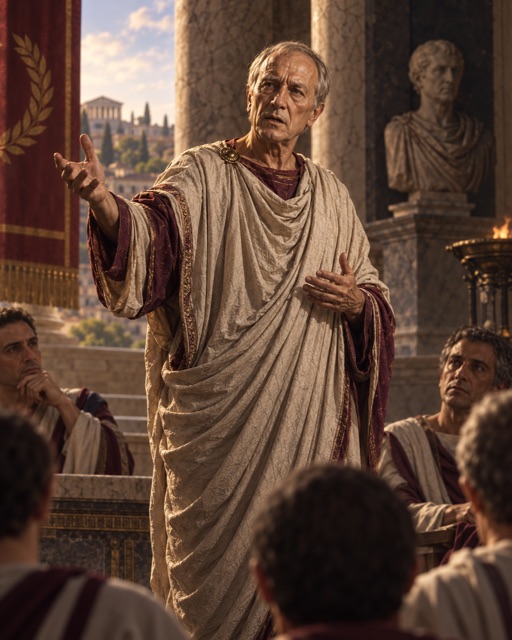
Roman Republicanism · Dialogue
On the Commonwealth
by Cicero · The Last Republican · Late Roman Republic, 106-43 BC
Cicero's surviving Republic asks how justice, mixed government, statesmanship, and cosmic perspective sustain a commonwealth.
- Brutal
- ~3 hr read
- 3 chapter guides
- Public domain
Start reading · Read the Book I guide free
Before the text
Editor's Prelude
A Republic in Fragments
Rome can win wars and still be divided against itself. In Cicero's philosophical dialogue, Scipio Africanus and his companions turn from a reported double sun to a more urgent division: Rome seems to have become two peoples. Their conversation asks what can hold a political community together.
The problem is larger than finding a good ruler. Kings can become tyrants, leading citizens can serve themselves, and popular freedom can become another form of domination. Scipio favors a mixed government in which different parts of the community share power. Justice and the habits of those who govern remain tests of whether that balance can last.
The dialogue survives in fragments, with long gaps and passages preserved by later writers. Editorial introductions help connect these pieces. Across them, public service is both a practical duty and a question about the value of a human life.
The opening pages
Book I — Part 1
BOOK I.
I. [Without the virtue of patriotism], neither Caius Duilius, nor Aulus Atilius, nor Lucius Metellus, could have delivered Rome by their courage from the terror of Carthage; nor could the two Scipios, when the fire of the second Punic War was kindled, have quenched it in their blood; nor, when it revived in greater force, could either Quintus Maximus have enervated it, or Marcus Marcellus have crushed it; nor, when it was repulsed from the gates of our own city, would Scipio have confined it within the walls of our enemies.
But Cato, at first a new and unknown man, whom all we who aspire to the same honors consider as a pattern to lead us on to industry and virtue, was undoubtedly at liberty to enjoy his repose at Tusculum, a most salubrious and convenient retreat. But he, mad as some people think him, though no necessity compelled him, preferred being tossed about amidst the tempestuous waves of politics, even till extreme old age, to living with all imaginable luxury in that tranquillity and relaxation. I omit innumerable men who have separately devoted themselves to the protection of our Commonwealth; and those whose lives are within the memory of the present generation I will not mention, lest any one should complain that I had invidiously forgotten himself or some one of his family. This only I insist on—that so great is the necessity of this virtue which nature has implanted in man, and so great is the desire to defend the common safety of our country, that its energy has continually overcome all the blandishments of pleasure and repose.
II. Nor is it sufficient to possess this virtue as if it were some kind of art, unless we put it in practice. An art, indeed, though not exercised, may still be retained in knowledge; but virtue consists wholly in its proper use and action. Now, the noblest use of virtue is the government of the Commonwealth, and the carrying-out in real action, not in words only, of all those identical theories which those philosophers discuss at every corner. For nothing is spoken by philosophers, so far as they speak correctly and honorably, which has not been discovered and confirmed by those persons who have been the founders of the laws of states. For whence comes piety, or from whom has religion been derived? Whence comes law, either that of nations, or that which is called the civil law? Whence comes justice, faith, equity? Whence modesty, continence, the horror of baseness, the desire of praise and renown? Whence fortitude in labors and perils? Doubtless, from those who have instilled some of these moral principles into men by education, and confirmed others by custom, and sanctioned others by laws.
Chapter guides · 3
Book I
Power Divided, a People United
Cicero makes public service the exercise of virtue. In the dialogue, Scipio asks what holds a people together and favors a constitution that distributes power among a chief, leading citizens and the people.
Virtue has work to do
Cicero challenges the philosopher who waits for an emergency before entering public life. The knowledge and standing needed to help a country cannot be acquired at the instant of danger. Laws give practical force to duties that philosophy teaches, and the commonwealth has a claim on the abilities it has helped to nourish.
More than a crowd
The conversation turns from a reported double sun to the divisions troubling Rome. Scipio defines a people through agreement about justice and a shared interest, rather than mere numbers. His accounts of popular and aristocratic government include arguments made by their advocates. They expose competing demands for liberty, rank and wise judgment; they are not all statements of his own preference.
The good ruler is not enough
If forced to choose one simple form, Scipio prefers kingship. But a good king can be followed by a tyrant, just as the other forms can turn into domination. His preferred mixture gives each part of the community a share in government and a check on the others. The appeal to Rome's ancestral constitution sits beside the speakers' recognition that their present commonwealth falls short of it.
What the fragments keep
The book ends in fragments. A country gives the greatest benefits and is owed even warmer gratitude than parents. Carthage flourished for six centuries because of wisdom and good institutions. Set beside what statesmen actually achieve, the reasonings of philosophers seem less a service to the business of life than an “amusement for their leisure.”
Introduction to the Third Book, by the Original Translator
Institutions Need Justice
Scipio traces Rome's constitution through the work of many generations. The history tests how divided powers restrain rulers, but it also raises a question that institutional design alone cannot answer: what makes their rule just?
A constitution made over time
Following Cato, Scipio contrasts Rome's accumulated experience with a state designed by one lawgiver. Kings, senators and citizens each contribute to its formation. Laelius nevertheless questions how far the apparent wisdom of the result can be credited to foresight rather than necessity or chance. The historical example is an argument under discussion, not an uncontested model.
When restraints disappear
The decemvirs show what happens when authority has no effective counterweight. Their office initially serves the making of laws; its holders then retain power without successors or appeal and use it oppressively. Scipio's account also gives property and rank unequal weight in government. His ideal of harmony among orders does not mean an equal share of power for every citizen.
Concord depends on conduct
Tubero asks for more than praise of Rome: he wants to know how its institutions are preserved. Scipio turns to the ruler's discipline of his own desires and to justice as the condition of civic concord. The translator's ensuing introduction quotes Augustine's account of the debate over injustice, assigning Philus the opposing case without making it his conviction. That framing must be distinguished from a continuous surviving speech.
Introduction to the Fifth Book, by the Original Translator
The Cost of Calling Power Just
The debate tests whether justice can survive a conflict with advantage. Its answer makes justice necessary to a commonwealth, while the surviving fragments also reveal the hierarchy and coercion that this account can defend.
Questions readers ask
- How long does it take to read On the Commonwealth?
- About 3 hr in total.
- How difficult is On the Commonwealth?
- Brutal. A mid-length dialogue; about 3 hours of reading.
- Which translation is this?
- The Francis Barham (1841), revised by C. D. Yonge translation from the Latin. The text follows Cicero's Tusculan Disputations; Also, Treatises on the Nature of the Gods, and on the Commonwealth (New York: Harper & Brothers, 1877).
- Can I read On the Commonwealth for free?
- On the Commonwealth is part of Nexus Premium, so reading it needs an account and a Premium subscription. The opening above and two chapter guides on this page are free to read.
- How many chapter guides are there?
- 3 chapter guides, written by the Nexus editors. Two open in full here; the rest show their opening line.
About Cicero
Marcus Tullius Cicero was a Roman statesman, lawyer, orator, and philosopher. He defended republican government, moral duty, natural law, friendship, rhetoric, and civic virtue during the violent collapse of the Roman Republic.
“What does a citizen owe to a republic that is falling apart?”
Cicero gives Nexus a bridge between philosophy and statesmanship. His life and writings show what happens when moral argument meets political collapse.
Source text: public domain. Chapter guides: original Nexus writing. On the Commonwealth is part of The Nexus Archive, guided Quests through the great works.