 The Nexus Archive
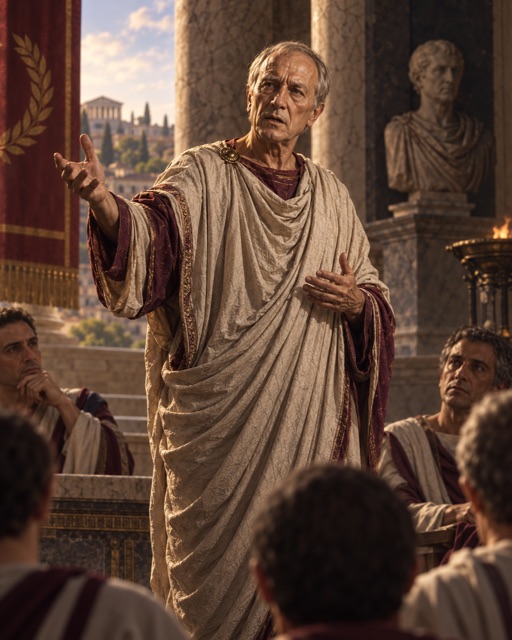
Roman Republicanism · Treatise
On Duties
by Cicero · The Last Republican · Late Roman Republic, 106-43 BC
Cicero's classic work on honor, usefulness, virtue, and public responsibility.
- Advanced
- 44 BCE
- ~4 hr 30 min read
- 32 chapter guides
- Public domain
Start reading · Read the Book I guide free
Before the text
Editor's Prelude
A Father Writes While the Republic Breaks
Late in 44 BCE, Cicero wrote to his son Marcus in Athens while Roman public life was collapsing around him. Caesar had been assassinated, the hoped-for restoration had failed, and armed men were deciding questions the old republic had once argued through law. On Duties takes the form of a father's instruction. Behind it stands a statesman asking what right conduct can still demand when institutions no longer hold.
Duty reaches into ordinary life: a favour to a friend, a bargain with a stranger, a promise that becomes costly to keep. Cicero brings Greek philosophy into these decisions, alongside stories from Roman public life and his own experience. His voice moves between explanation, argument, example, and a father's hopes for his son. The demands of justice sit beside the loyalties and assumptions of his Roman world.
One question holds the three books together: can an action be truly useful if it is wrong? Wealth, reputation, friendship, and survival all place pressure on the answer. Cicero seeks a standard strong enough to guide people who must choose among competing obligations. The bonds between people give those choices their weight, even while the republic he served is coming apart.
The opening pages
Book I: Moral Goodness
1 I. My dear son Marcus, you have now been studying a full year under Cratippus, and that too in Athens, and you should be fully equipped with the practical precepts and the principles of philosophy; so much at least one might expect from the pre-eminence not only of your teacher but also of the city; the former is able to enrich you with learning, the latter to supply you with models. Nevertheless, just as I for my own improvement have always combined Greek and Latin studies—and I have done this not only in the study of philosophy but also in the practice of oratory—so I recommend that you should do the same, so that you may have equal command of both languages. And it is in this very direction that I have, if I mistake not, rendered a great service to our countrymen, so that not only those who are unacquainted with Greek literature but even the cultured consider that they have gained much both in oratorical power and in mental training.
2 You will, therefore, learn from the foremost of present-day philosophers, and you will go on learning as long as you wish; and your wish ought to continue as long as you are not dissatisfied with the progress you are making. For all that, if you will read my philosophical books, you will be helped; my philosophy is not very different from that of the Peripatetics (for both they and I claim to be followers of Socrates and Plato). As to the conclusions you may reach, I leave that to your own judgment (for I would put no hindrance in your way), but by reading my philosophical writings you will be sure to render your mastery of the Latin language more complete. But I would by no means have you think that this is said boastfully. For there are many to whom I yield precedence in knowledge of philosophy; but if I lay claim to the orator's peculiar ability to speak with propriety, clearness, elegance, I think my claim is in a measure justified, for I have spent my life in that profession.
3 And therefore, my dear Cicero, I cordially recommend you to read carefully not only my orations but also these books of mine on philosophy, which are now about as extensive. For while the orations exhibit a more vigorous style, yet the unimpassioned, restrained style of my philosophical productions is also worth cultivating. Moreover, for the same man to succeed in both departments, both in the forensic style and in that of calm philosophic discussion has not, I observe, been the good fortune of any one of the Greeks so far, unless, perhaps, Demetrius of Phalerum can be reckoned in that number—a clever reasoner, indeed, and, though rather a spiritless orator, he is yet charming, so that you can recognize in him the disciple of Theophrastus. But let others judge how much I have accomplished in each pursuit; I have at least attempted both.
Chapter guides · 32
Book I: Moral Goodness
Duty Starts With Character
Duty belongs to every part of life, and justice begins with how people treat one another.
Main idea
Duty means the obligations that guide a person’s actions. Cicero treats it as a concern of daily life, not just public office. He links good conduct to four virtues: wisdom, justice, courage, and self-control.
Recap
Cicero first addresses Marcus, his son studying in Athens, and encourages both Greek and Latin learning. He then explains the questions that guide decisions about duty. Reason leads people to seek truth, care for others, and live in an orderly way. The discussion turns to justice, shared resources, and respect for property. It ends with causes of wrongdoing: fear, greed, and ambition. Cicero judges a planned injury more harshly than one committed in a sudden passion.
Book I: Injustice and Conflicting Duties
Justice Is Not Only Non-Harm
Failing to protect someone can be unjust, and keeping a promise can sometimes cause harm.
Main idea
Justice requires more than avoiding harm. It also requires help when another person needs protection. A rule about promises cannot replace judgment about what a promise would actually do.
Recap
Cicero describes people who neglect others because they fear trouble or care only about their own affairs. He then considers promises that circumstances have made harmful. A son’s sudden illness can outweigh his father’s appointment to act as a lawyer. Deception also makes legal cleverness unjust: a truce limited to days does not excuse attacks at night. The section ends by limiting punishment to preventing renewed wrongdoing and discouraging others from it.
Book I: War, Mercy, and Promises
War Still Has Moral Limits
Even an enemy remains subject to rules of justice.
Book I: Generosity and Common Bonds
Generosity Must Stay Just
A gift is not generous if it harms others or exceeds what the giver can afford.
Book I: Society and Beneficence
Duty Becomes Social
Human bonds create duties, while real courage must serve justice.
Book I: Courage and Temperance
Courage Needs Judgment
Courage and outward conduct both need self-control.
Book I: Nature and Character
Character Has a Shape
Good conduct must fit both shared human nature and a person’s own abilities.
Book I: Choosing a Life
Choosing A Role
Choosing a way of life requires attention to character, circumstances, and inherited duties.
Book I: Age, Office, and Propriety
Propriety Becomes Visible
Propriety takes different forms at different ages and in different positions.
Book I: Speech and Conversation
Speech Shows Character
Conversation and possessions reveal whether a person acts with restraint.
Book I: Order and Custom
Order Is A Moral Habit
An action needs the right measure, time, and place.
Book I: Work, Study, and Society
Society Comes Before Study
Learning reaches its highest purpose when it helps other people.
Book I: The Highest Duties
Good Duties Still Need Ranking
Serving others has priority, but it cannot justify a shameful act.
Book II: Expediency
Usefulness Enters
Useful achievements depend on cooperation, and fear provides weak security.
Book II: Reputation and Public Trust
Trust Is Political Capital
Injustice makes power unstable, even when it seems profitable.
Book II: Goodwill, Confidence, and Esteem
Public Trust Has Parts
Justice wins goodwill, trust, and admiration.
Book II: Justice, Glory, and Public Life
Glory Must Be Earned Honestly
Honest character supports public reputation, while speech can put it into action.
Book II: Giving, Wealth, and Public Spending
Generosity Needs Judgment
Public giving needs a useful purpose and a limit.
Book II: Charity, Hospitality, and Civic Service
Service Is Better Than Show
Kindness should answer real need and avoid injuring someone else.
Book II: Character, Property, and Public Duty
Public Duty Must Stay Clean
Public help should protect the community and remain free of greed.
Book II: Public Wealth and Private Gain
Public Wealth Is a Moral Test
Public prosperity requires honest officials and fair treatment of competing claims.
Book III: Forced Leisure and Moral Duty
A Father Writes in Forced Leisure
Forced withdrawal from politics gives Cicero time to write to Marcus.
Book III: Panaetius and the Missing Question
Usefulness Cannot Split From Right
What looks useful must be judged by the same standard as what is right.
Book III: Fellowship Against Private Gain
Private Gain Has A Limit
Taking another person’s resources for private gain breaks human fellowship.
Book III: Advantage and Justice
Profit Meets Justice
A secret wrongdoing still harms the person who commits it.
Book III: Friendship and Moral Limits
Friendship Has Moral Limits
Loyalty to a friend cannot cancel justice.
Book III: State Advantage and Moral Right
States Cannot Excuse Cruelty
A city’s safety cannot turn cruelty into a true advantage.
Book III: Disclosure and Honest Exchange
Honesty Includes What You Withhold
Honesty can require telling a buyer something the seller would rather conceal.
Book III: Honest Dealing
Honesty Still Counts
Fair dealing requires more than escaping a narrow legal rule.
Book III: Secret Gain and Honor
Hidden Gain Is Still Wrong
Gaining money or honour through someone else’s dishonesty still damages character.
Book III: Power and False Utility
Power Cannot Rename Wrong
Power, profit, and safety do not by themselves make an action right.
Book III: The Final Test
Cicero Closes the Test
Keeping faith and acting justly matter more to Cicero than comfort or private gain.
Questions readers ask
- How long does it take to read On Duties?
- About 4 hr 30 min in total.
- How difficult is On Duties?
- Advanced. A long treatise; about 4 hours of reading.
- Which translation is this?
- The Walter Miller translation from the Latin, first published in -44. The text follows De Officiis (1913).
- Can I read On Duties for free?
- On Duties is part of Nexus Premium, so reading it needs an account and a Premium subscription. The opening above and two chapter guides on this page are free to read.
- How many chapter guides are there?
- 32 chapter guides, written by the Nexus editors. Two open in full here; the rest show their opening line.
About Cicero
Marcus Tullius Cicero was a Roman statesman, lawyer, orator, and philosopher. He defended republican government, moral duty, natural law, friendship, rhetoric, and civic virtue during the violent collapse of the Roman Republic.
“What does a citizen owe to a republic that is falling apart?”
Cicero gives Nexus a bridge between philosophy and statesmanship. His life and writings show what happens when moral argument meets political collapse.
Source text: public domain. Chapter guides: original Nexus writing. On Duties is part of The Nexus Archive, guided Quests through the great works.