 The Nexus Archive
Roman Republicanism · Speech
Catilinarian Orations
by Cicero · The Last Republican · Late Roman Republic, 106-43 BC
The four crisis speeches Cicero delivered against Catiline during the conspiracy of 63 BCE.
- Advanced
- 63 BCE
- ~1 hr 45 min read
- 14 chapter guides
- Public domain
Start reading · Read the First Oration guide free
Before the text
Editor's Prelude
The Consul Takes the Floor
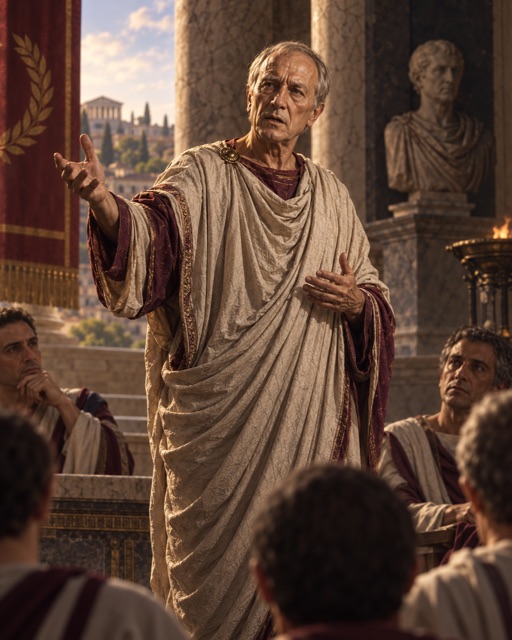
In the last months of 63 BCE, Rome's consul rose in a guarded Senate chamber and addressed an accused conspirator sitting among the men he was said to have marked for death. Cicero does not begin by proving a case from neutral ground. He begins at full pressure: Catiline is present, the city is afraid, and every delay can be made to look like complicity.
The four speeches keep changing their audience and their task. Cicero first confronts Catiline face to face, then tells the Roman people why allowing him to leave was a victory. When intercepted letters expose the men left behind, celebration gives way to judgment: the Senate must decide whether an emergency permits the harshest punishment of citizens.
Public persuasion works through questions that do not invite answers, enemies made visible by naming, fear converted into unity, and the speaker's own courage placed at the center of the republic's survival. The final appeal joins the republic’s safety to Cicero’s own future: he asks the senators to remember his consulship, protect his son, and decide boldly, while pledging to carry out their decree. His defense of constitutional order presses against the legal protections of the citizens accused of threatening it.
The opening pages
First Oration: Source Context
Selection
This route presents all four complete speeches against Catiline from C. D. Yonge's translation in The Orations of Marcus Tullius Cicero, Vol. II.
The source volume contains other orations before and after this continuous four-speech sequence. Yonge's historical argument remains separate from Cicero's speech at the start of each oration.
Source Context
First Oration: Yonge's Historical Argument
Delivered in the Senate
Lucius Catiline, a man of noble extraction, and who had already been praetor, had been a competitor of Cicero's for the consulship; the next year he again offered himself for the office, practicing such excessive and open bribery, that Cicero published a new law against it, with the additional penalty of ten years' exile; prohibiting likewise all shows of gladiators from being exhibited by a candidate within two years of the time of his suing for any magistracy, unless they were ordered by the will of a person deceased. Catiline, who knew this law to be aimed chiefly at him, formed a design to murder Cicero and some others of the chief men of the senate, on the day of election, which was fixed for the twentieth of October. But Cicero had information of his plans, and laid them before the senate, on which the election was deferred, that they might have time to deliberate on an affair of so much importance. The day following, when the senate met, he charged Catiline with having entertained this design, and Catiline's behaviour had been so violent, that the senate passed the decree to which they had occasionally recourse in times of imminent danger from treason or sedition, “Let the consuls take care that the republic suffers no harm.” This decree invested the consuls with absolute power, and suspended all the ordinary forms of law, till the danger was over. On this Cicero doubled his guards, introduced some additional troops into the city, and when the elections came on, he wore a breastplate under his robe for his protection; by which precaution he prevented Catiline from executing his design of murdering him and his competitors for the consulship, of whom Decius Junius Silanus and Lucius Licinius Murena were elected.
Catiline was rendered desperate by this his second defeat, and resolved without further delay to attempt the execution of all his schemes. His greatest hopes lay in Sulla's veteran soldiers, whose cause he had always espoused. They were scattered about in the different districts and colonies of Italy; but he had actually enlisted a considerable body of them in Etruria, and formed them into a little army under the command of Manlius, a centurion of considerable military experience, who was only waiting for his orders. He was joined in his conspiracy by several senators of profligate lives and desperate fortunes, of whom the chiefs were Publius Cornelius Lentulus, Caius Cethegus, Publius Autronius, Lucius Cassius Longinus, Marcus Porcius Lecca, Publius Sulla, Servilius Sulla, Quintus Curius, Lucius Vargunteius, Quintus Annius, and Lucius Bestia. These men resolved that a general insurrection should be raised throughout all Italy; that Catiline should put himself at the head of the troops in Etruria; that Rome should be set on fire in many places at once and that a general massacre should be made of all the senate, and of all their enemies, of whom none were to be spared but the sons of Pompey, who were to be kept as hostages, and as a check upon their father, who was in command in the east. Lentulus was to be president of their councils, Cassius was to manage the firing of the city, and Cethegus the massacre. …
Read it in a Quest
A republic under pressure, where duty, ambition, and civil order begin to fracture.
Chapter guides · 14
First Oration: Source Context
The Crisis Is Already Moving
Yonge's context turns the speeches into one unfolding emergency.
What just happened
Yonge’s historical introduction follows the danger through elections, armed plans, and private intelligence. Catiline is presented as more than a rival candidate: Yonge describes a conspiracy to burn Rome and murder political opponents, and Cicero’s efforts to prevent the attack on himself.
Why it matters
The source context helps explain why the First Oration begins at such a high pitch. Cicero is not trying to discover whether danger exists. He is trying to make the Senate act as if everyone finally knows it.
The confrontation is set
Yonge’s account ends with Catiline entering the Senate despite the exposed plans. No one greets him, and the senior senators leave the neighboring seats empty. Cicero responds with a direct invective. The silence and the empty bench already make the confrontation public before the speech begins.
First Oration: Catiline Is Called Out
The Attack Begins Face to Face
Cicero’s questions isolate Catiline before the Senate.
What just happened
Cicero opens by asking why Catiline is still alive, still present, and still tolerated. The questions are not polite inquiry. They are a public attempt to isolate him in front of the Senate.
Why it matters
This is rhetoric as pressure. Cicero wants every senator to feel that hesitation has become dangerous. He presents patience not as mercy, but as a weakness the conspiracy is exploiting.
The failed visit at dawn
Cicero ends this movement by naming the meeting at Lecca’s house and the two knights assigned to kill him in bed. He says he learned the plan before the meeting dispersed, warned prominent men, fortified his house, and refused the visitors entry. The closing example makes advance knowledge the basis of his claim to control the crisis.
First Oration: Catiline Must Leave
Departure Becomes a Trap
Cicero presents Catiline’s departure as a way to draw his followers out of Rome.
First Oration: Exile, Enemy, and Warning
Cicero Forces the Crisis Into Speech
The first oration turns suspicion into public confrontation.
Second Oration: Catiline Leaves Rome
Cicero Explains the Exit
Catiline's departure has to look like victory, not escape.
Second Oration: The Conspirators Named
The Threat Has Social Roots
Cicero turns Catiline's followers into a map of civic decay.
Second Oration: Rome Is Put on Guard
Rome Is Put on Guard
Cicero contrasts the remaining followers’ motives with the republic’s resources and resolve.
Third Oration: Source Context
The Case Finds Its Proof
The third speech begins after Cicero turns intelligence into evidence.
Third Oration: The Plot Comes to Light
Cicero Announces Deliverance
The city is told that it has been saved from fire, sword, and collapse.
Third Oration: Letters, Confession, and Proof
Evidence Becomes Unavoidable
Letters and testimony make the conspiracy visible in public.
Third Oration: Gods, Gratitude, and Memory
The City Sees the Plot
Cicero turns proof into thanksgiving, memory, and public unity.
Fourth Oration: The Senate Must Decide
Judgment Replaces Exposure
The Fourth Oration begins after proof has created a harder question.
Fourth Oration: Caesar, Silanus, and Punishment
Mercy, Law, and Fear Collide
Cicero argues that the republic's safety must outweigh his personal danger.
Fourth Oration: Cicero Accepts the Burden
Cicero Stakes Himself on the Vote
The speech closes by binding Cicero's future to the Senate's decision.
Questions readers ask
- How long does it take to read Catilinarian Orations?
- About 1 hr 45 min in total.
- How difficult is Catilinarian Orations?
- Advanced. A mid-length speech; about 2 hours of reading.
- Which translation is this?
- The Charles Duke Yonge translation from the Latin. The text follows The Orations of Marcus Tullius Cicero, Vol. II (1852).
- Can I read Catilinarian Orations for free?
- Catilinarian Orations is part of Nexus Premium, so reading it needs an account and a Premium subscription, and completing an earlier Quest's Mastery. The opening above and two chapter guides on this page are free to read.
- How many chapter guides are there?
- 14 chapter guides, written by the Nexus editors. Two open in full here; the rest show their opening line.
About Cicero
Marcus Tullius Cicero was a Roman statesman, lawyer, orator, and philosopher. He defended republican government, moral duty, natural law, friendship, rhetoric, and civic virtue during the violent collapse of the Roman Republic.
“What does a citizen owe to a republic that is falling apart?”
Cicero gives Nexus a bridge between philosophy and statesmanship. His life and writings show what happens when moral argument meets political collapse.
Source text: public domain. Chapter guides: original Nexus writing. Catilinarian Orations is part of The Nexus Archive, guided Quests through the great works.