 The Nexus Archive
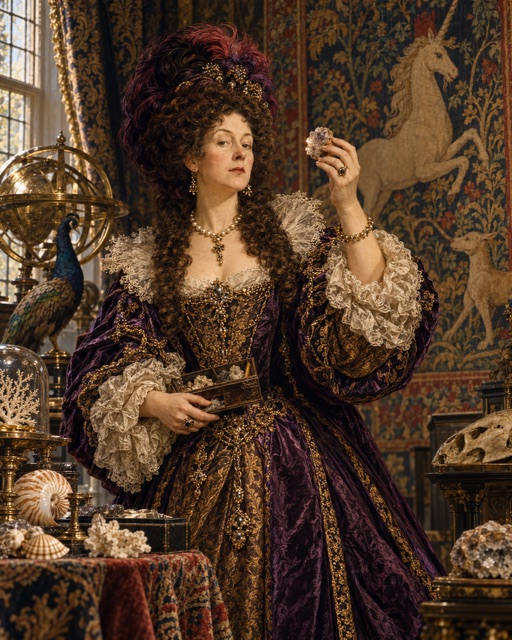
Natural Philosophy and Early Feminism · Novel
The Blazing World
by Margaret Cavendish · The Sovereign of Imagination · Seventeenth-Century England, 1623-1673
Cavendish's speculative philosophical fiction joins natural philosophy, political imagination, gender, and intellectual authority.
- Advanced
- 1666
- ~3 hr read
- 18 chapter guides
- Public domain
Start reading · Read the To All Noble and Worthy Ladies guide free
Before the text
Editor's Prelude
A World Large Enough for Margaret Cavendish
Margaret Cavendish wants a world large enough for her ambition. In her address to women readers, she imagines sharing its diamonds with friends and using its gold to repair her husband’s losses. Then she names a different desire: to be Margaret the First, ruler of a world she has made herself. Private wishes and public power belong to the same invention.
The Blazing World joins romance, philosophical argument and fantasy. Its marvels give questions about nature a voice and a setting. What can a telescope really establish? Does matter need a spirit to move it? Learned creatures disagree, a ruler demands answers, and friendship opens room for thought beyond the schools. Cavendish puts herself into the conversation as the Duchess of Newcastle, a writer with opinions and ambitions of her own.
Her imagined freedom has a demanding political form: one sovereign, one language and one religion. The book gives women intellectual command while making unity and obedience conditions of peace. Its pleasures sit beside that pressure. A mind can create the room it lacks, but the world it makes still raises questions about whose judgment prevails and what power asks of others.
The opening pages
Two Poems for a New World

Here on this Figure Cast a Glance.
But so as if it were by Chance,
Your eyes not fixt, they must not Stay,
Since this like Shadowes to the Day
It only represent's; for Still,
Her Beauty's found beyond the Skill
Of the best Paynter, to Imbrace
These lovely Lines within her face.
View her Soul's Picture, Judgment, witt,
Then read those Lines which Shee hath writt,
By Phancy's Pencill drawne alone
Which Peces but Shee, can justly owne.
To The Duchesse of Newcastle, On Her New Blazing-World.
Our Elder World, with all their Skill and Arts,
Could but divide the World into three Parts:
Columbus, then for Navigation fam'd,
Found a new World, America 'tis nam'd;
Now this new World was found, it was not made,
Onely discovered, lying in Time's shade.
Then what are You, having no Chaos found
To make a World, or any such least ground?
But your Creating Fancy, thought it fit
To make your World of Nothing, but pure Wit.
Your Blazing-World, beyond the Stars mounts higher,
Enlightens all with a Cœlestial Fier.
William Newcastle.
To All Noble and Worthy Ladies
This present Description of a New World, was made as an Appendix to my Observations upon Experimental Philosophy; and, having some Sympathy and Coherence with each other, were joyned together as Two several Worlds, at their Two Poles. But, by reason most Ladies take no delight in Philosophical Arguments, I separated some from the mentioned Observations, and caused them to go out by themselves, that I might express my Respects, in presenting to Them such Fancies as my Contemplations did afford. The First Part is Romancical; the Second, Philosophical; and the Third is meerly Fancy; or (as I may call it) Fantastical. And if (Noble Ladies) you should chance to take pleasure in reading these Fancies, I shall account my self a Happy Creatoress: If not, I must be content to live a Melancholly Life in my own World; which I cannot call a Poor World, if Poverty be only want of Gold, and Jewels: for, there is more Gold in it, than all the Chymists ever made; or, (as I verily believe) will ever be able to make. As for the Rocks of Diamonds, I wish, with all my Soul, they might be shared amongst my Noble Female Friends; upon which condition, I would willingly quit my Part: And of the Gold, I should desire only so much as might suffice to repair my Noble Lord and Husband's Losses: for, I am not Covetous, but as Ambitious as ever any of my Sex was, is, or can be; which is the cause, That though I cannot be Henry the Fifth, or Charles the Second; yet, I will endeavour to be, Margaret the First: and, though I have neither Power, Time nor Occasion, to be a great Conqueror, like Alexander, or Cesar; yet, rather than not be Mistress of a World, since Fortune and the Fates would give me none, I have made One of my own. And thus, believing, or, at least, hoping, that no Creature can, or will, Envy me for this World of mine, I remain,
Read it in a Quest
A demand for intellectual authority, equal dignity, and citizenship without permission.
Chapter guides · 18
To All Noble and Worthy Ladies
Cavendish Announces the Rules of Her World
An invented world gives Cavendish room for an ambition that ordinary life cannot satisfy.
Creation as power
Cavendish presents imagination as a way to become a ruler. She addresses women readers and calls herself ambitious, rather than greedy for wealth. Her three modes are romance, philosophical argument and fantasy.
What happened
She explains why she joined this work to her writing on experimental philosophy, then let it appear separately. She wishes its diamonds could go to her female friends and its gold could repair her husband’s losses. Unable to be Henry V or Charles II, she imagines herself Margaret I. She closes by saying that fortune gave her no world to govern, so she made one, and signs herself the ladies’ humble servant.
A Passage Between Worlds
Abduction Becomes Translation
The woman survives abduction and finds unexpected kindness, then power, in another world.
From captivity to command
The woman’s fear begins to ease as she learns the strangers’ language and finds them kind. The merchant who steals her away treats her as a possession. In the new world, she gains authority of her own.
What happened
A merchant abducts her from the shore. A storm drives his boat through the joined poles of two worlds, and every man aboard freezes to death. Bear-men rescue her and help escort her through other peoples’ lands. She learns their language during the journey. At Paradise, the imperial city, she sees a magnificent palace. The Emperor first takes her for a goddess. When she says she is mortal, he marries her and gives her absolute governing power. Her subjects still offer her divine worship.
An Empress, a Realm, and a Palace
Order Looks Like Unity—and Control
The realm combines many kinds of people with tightly controlled political and religious authority.
Astronomy and Microscopes
Instruments Multiply Disagreement
The Empress asks whether instruments reveal truth when their users still disagree about what they see.
Seas, Frost, and Living Matter
Matter Is Alive All the Way Down
The fish-men and worm-men describe a changing nature whose creatures perceive it in different ways.
Chymists and Physicians
Chymistry and Medicine Meet Their Limits
The Empress wants useful experiments, while the physicians defend knowledge aimed at preserving life.
Measure, Logic, and Reform
The Empress Reforms Knowledge by Command
The Empress prefers plain understanding to elaborate methods, then uses spectacle to strengthen religious belief.
Spirits and the Cabbala
The Story Opens into the Spirit World
Even the immaterial spirits depend on bodies for movement and have limits to their knowledge.
Numbers, Souls, and Knowledge
No System Gets the Last Word
The Empress mistakes the spirits’ sudden departure for a disaster, then learns that they are safe.
The Duchess Is Summoned
The Author Enters as a Soul
The Duchess becomes the Empress’s friend, then seeks a world of her own.
Worlds Made in the Mind
World-Making Outruns Fame
Making a world of her own succeeds where the Duchess’s borrowed systems failed.
Fortune Puts the Duke on Trial
Fortune Is Put on Trial
The Duchess defends her husband’s conscience and honour against Fortune’s account of his failures.
Honesty Answers Fortune
Honesty Breaks the Courtly Script
Honesty cannot win Fortune’s favour, while the Duchess shows that a true friend can correct a ruler.
The Second Part
The Second Part Turns Thought into War
The Duchess plans to save the Empress’s homeland with the Blazing World’s creatures and materials.
The Empress Crosses the Seas
Spectacle Saves the Native Country
The Empress saves her homeland’s fleet, then makes other nations pay tribute to its king.
Fire-Stones and Absolute Rule
Liberation Becomes Empire
The Empress turns resistance to tribute into the destruction of towns and the extension of absolute rule.
Return, Theatre, and Recreation
The Duchess Comes Home Still Imagining
The return brings the Duchess back to her husband, while imagination still supplies pleasures ordinary life cannot.
The Epilogue to the Reader
Authorship Is Her Conquest
Cavendish claims the glory of creating worlds and protects the freedom to govern her own inventions.
Questions readers ask
- How long does it take to read The Blazing World?
- About 3 hr in total.
- How difficult is The Blazing World?
- Advanced. A mid-length novel; about 3 hours of reading.
- Which edition is this?
- The original English text, first published in 1666. The text follows The Description of a New World, Called The Blazing-World (1668).
- Can I read The Blazing World for free?
- The Blazing World is part of Nexus Premium, so reading it needs an account and a Premium subscription, and completing an earlier Quest's Mastery. The opening above and two chapter guides on this page are free to read.
- How many chapter guides are there?
- 18 chapter guides, written by the Nexus editors. Two open in full here; the rest show their opening line.
About Margaret Cavendish
Margaret Cavendish, Duchess of Newcastle, was a seventeenth-century writer of philosophy, science, poetry, drama, and speculative fiction. Her work challenged assumptions about nature, knowledge, gender, and intellectual authority.
“Who gets permission to think in public?”
Cavendish gives Nexus a rare early modern voice where natural philosophy, literary invention, and women's intellectual authority meet.
Source text: public domain. Chapter guides: original Nexus writing. The Blazing World is part of The Nexus Archive, guided Quests through the great works.