 The Nexus Archive
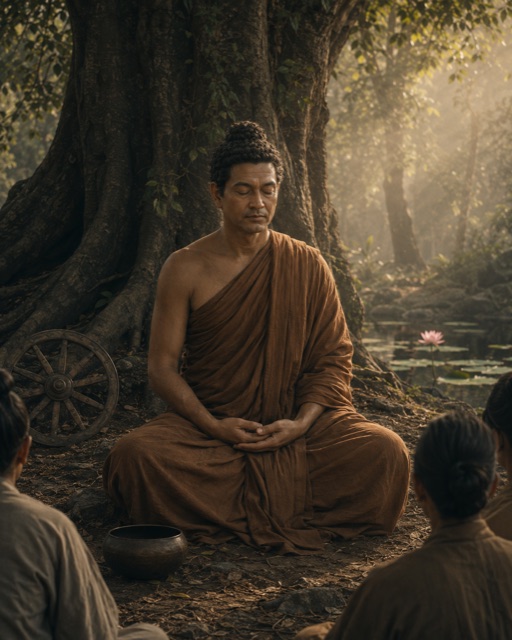
Buddhism · Formative text
The Gospel of Buddha
by Paul Carus
Featuring The Buddha
A narrative compilation of the Buddha's life and teachings.
- Intermediate
- 1894
- ~5 hr 15 min read
- 9 chapter guides
- Public domain
Start reading · Read the Compiler's Preface guide free
Before the text
Editor's Prelude
A Life Woven from Many Records
Paul Carus did not set out to translate one Buddhist scripture. He gathered passages and episodes from many traditions into a single life of Siddhattha Gotama, shaped for readers at the end of the nineteenth century. First published in 1894, the book gives the Buddha's life the form of a gospel: a prince confronts suffering, leaves his family, and seeks a freedom that wealth and rank cannot provide. It remains a modern compilation rather than a canonical Buddhist text.
Carus wanted Western readers to encounter Buddhism as a coherent religion of truth, ethical discipline, and release from suffering. He worked largely through translations and studies already available in European languages, copying some passages, abridging or rearranging others, and adding explanations of his own. His preface is candid about this method. Christian echoes in the language of salvation and everlasting life belong to his effort to bring religions into conversation.
The search for awakening also raises difficult human questions. A father's hopes, a wife's grief, and a child's inheritance stand beside the renunciant's vocation. Monks depend on householders for food and shelter; disputes test the community's rules and its capacity for reconciliation. Teachings about desire, impermanence, and the absence of an enduring self take shape among people whose loyalties and losses do not disappear when they hear them.
The opening pages
Prince Siddhattha Becomes Buddha: The Bodhisatta's Birth to The Three Woes

View the full illustrated page

Prince Siddhattha Becomes Buddha
IV. The Bodhisatta's Birth
There was in Kapilavatthu a Sakya king, strong of purpose and reverenced by all men, a descendant of the Okkākas, who call themselves Gotama, and his name was Suddhodana or Pure-Rice.
His wife Māyā-devī was beautiful as the water-lily and pure in mind as the lotus. As the Queen of Heaven, she lived on earth, untainted by desire, and immaculate.
The king, her husband, honored her in her holiness, and the spirit of truth, glorious and strong in his wisdom like unto a white elephant, descended upon her.
When she knew that the hour of motherhood was near, she asked the king to send her home to her parents; and Suddhodana, anxious about his wife and the child she would bear him, willingly granted her request.
At Lumbinī there is a beautiful grove, and when Māyā-devī passed through it the trees were one mass of fragrant flowers and many birds were warbling in their branches. The Queen, wishing to stroll through the shady walks, left her golden palanquin, and, when she reached the giant Sāla tree in the midst of the grove, felt that her hour had come. She took hold of a branch. Her attendants hung a curtain about her and retired. When the pain of travail came upon her, four pure-minded angels of the great Brahmā held out a golden net to receive the babe, who came forth from her right side like the rising sun bright and perfect.
The Brahmā-angels took the child and placing him before the mother said: "Rejoice, O queen, a mighty son has been born unto thee."
At her couch stood an aged woman imploring the heavens to bless the child.
All the worlds were flooded with light. The blind received their sight by longing to see the coming glory of the Lord; the deaf and dumb spoke with one another of the good omens indicating the birth of the Buddha to be. The crooked became straight; the lame walked. All prisoners were freed from their chains and the fires of all the hells were extinguished.
No clouds gathered in the skies and the polluted streams became clear, whilst celestial music rang through the air and the angels rejoiced with gladness. With no selfish or partial joy but for the sake of the law they rejoiced, for creation engulfed in the ocean of pain was now to obtain release.
Chapter guides · 9
Compiler's Preface
A Compiler States His Purpose
Carus explains how borrowed passages, rearranged narratives, and his own additions became one gospel.
Borrowing and reshaping
Carus makes no claim to have translated a single original. Some passages are copied literally; others are freely rendered, abridged, or placed in a new order. He identifies the Introduction and Conclusion as his own work. Carus draws these materials from different sources into a continuous account.
Truth across religions
His comparisons with Christianity serve a larger ambition: a religion grounded in truth that could unite people across inherited divisions. His distinction between an enduring ego and the mental life carried forward through thoughts and deeds belongs to that philosophical project. He ends by placing Buddhism’s small boat, Hīnayāna, and large vessel, Mahāyāna, alongside Christianity’s great bridge, Mahāsetu. Carus places all three beneath a single Religion of Truth.
Introduction
Truth and the Vanishing Self
Carus opens with a religious argument before beginning the life of Siddhattha.
The compiler’s opening
These three sections are Carus’s own Introduction. They contrast the instability of compounded things with a truth that does not perish. The language of a saviour and a gospel places the Buddha inside the comparative religious vision announced in the preface.
What survives
The self that seeks lasting possession is presented as a source of pain and delusion. Carus opposes it to an identification with truth, expressed through knowledge and righteous action. His imagery gives truth a history through stone, plant, animal, and human life. The claim is larger than relief from an individual sorrow: existence reaches its purpose when truth becomes conscious and active.
Prince Siddhattha Becomes Buddha: The Bodhisatta's Search to Brahmā's Request
The End of Self-Mortification
Siddhattha’s search turns away from both an independent soul and the destruction of the body.
The Foundation of the Kingdom of Righteousness: The Buddha's Father to Rāhula
A Community and a Family
Public teaching creates new relationships without erasing the claims of Siddhattha’s household.
Consolidation of the Buddha's Religion: The Vanity of Worldliness to The Preacher's Mission
Care, Conduct, and Public Teaching
Freedom from suffering takes shape in care for others, honest conduct, and patient teaching.
The Teacher
A Teaching Tested in Conduct
Questions about self, duty, anger, and religious power receive different kinds of answers.
Parables and Stories
Compassion in Unequal Lives
The stories make giving, grief, and restraint concrete without making every ending gentle.
XCVII. The Buddha's Final Entering into Nirvāna
The Teacher Leaves the Teaching
Illness and death bring the question of the community’s continuing authority into the open.
Conclusion
Carus’s Religion of Truth
The Conclusion moves from the disciples’ inheritance to the compiler’s account of existence itself.
Questions readers ask
- How long does it take to read The Gospel of Buddha?
- About 5 hr 15 min in total.
- How difficult is The Gospel of Buddha?
- Intermediate. A long text; about 5 hours of reading.
- Can I read The Gospel of Buddha for free?
- The Gospel of Buddha is part of Nexus Premium, so reading it needs an account and a Premium subscription. The opening above and two chapter guides on this page are free to read.
- How many chapter guides are there?
- 9 chapter guides, written by the Nexus editors. Two open in full here; the rest show their opening line.
About The Buddha
Siddhartha Gautama, known as the Buddha, became the central figure of Buddhism. He left no authored text, so Nexus treats him through ancient teaching collections and later public-domain compilers rather than direct major works.
“What must be understood before suffering can loosen its grip?”
The Buddha gives Nexus a major tradition of moral psychology and spiritual discipline, built around attention, suffering, and transformation.
Source text: public domain. Chapter guides: original Nexus writing. The Gospel of Buddha is part of The Nexus Archive, guided Quests through the great works.