 The Nexus Archive
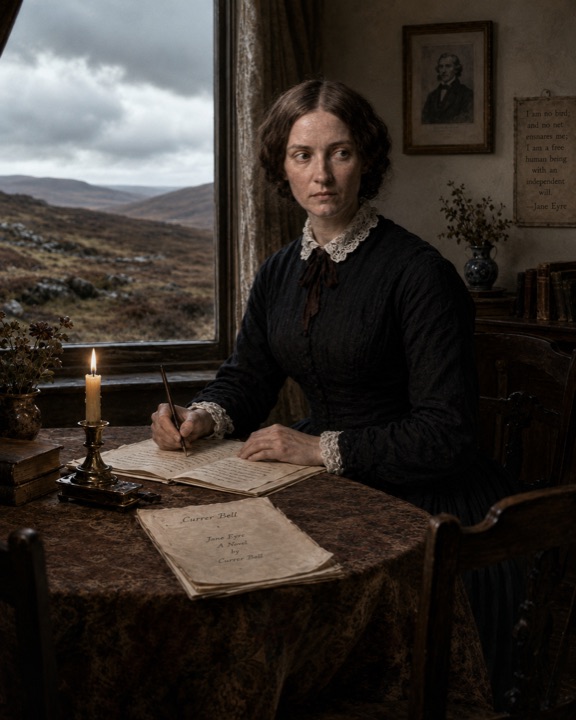
English Novel · Novel
Jane Eyre
by Charlotte Brontë · The Voice Against Confinement · Victorian England, 1816-1855
Brontë's full novel of childhood injury, education, work, love, conscience, and the fight to keep self-respect intact.
- Advanced
- 1847
- ~14 hr 15 min read
- 23 chapter guides
- Public domain
Start reading · Read the Dedication and Prefaces guide free
Before the text
Editor's Prelude
A Voice That Will Not Be Silenced
In 1847, Charlotte Brontë published Jane Eyre as Currer Bell. Its fictional autobiography lets a poor, plain governess address the reader in her own name and makes the inward life of a dependent woman impossible to dismiss. From childhood onward, Jane insists that suffering does not cancel judgment and that love cannot require the surrender of conscience.
The novel moves through houses that offer shelter at a price: Gateshead demands submission, Lowood disciplines body and spirit, Thornfield awakens desire while concealing its history, and Moor House proposes a life of duty emptied of intimacy. Jane is never choosing between freedom and attachment in the abstract. She is trying to discover whether she can belong anywhere without consenting to become less fully herself.
Authority borrows the language of morality, religion, class, and affection. Brontë's deepest conflicts begin when a powerful person offers Jane a version of goodness that would erase her own knowledge. The romance matters because the question beneath it is harder: what conditions make love compatible with truth, equality, and the command of one's own soul?
The opening pages
Chapter I
There was no possibility of taking a walk that day. We had been wandering, indeed, in the leafless shrubbery an hour in the morning; but since dinner (Mrs. Reed, when there was no company, dined early) the cold winter wind had brought with it clouds so sombre, and a rain so penetrating, that further outdoor exercise was now out of the question.
I was glad of it: I never liked long walks, especially on chilly afternoons: dreadful to me was the coming home in the raw twilight, with nipped fingers and toes, and a heart saddened by the chidings of Bessie, the nurse, and humbled by the consciousness of my physical inferiority to Eliza, John, and Georgiana Reed.
The said Eliza, John, and Georgiana were now clustered round their mama in the drawing-room: she lay reclined on a sofa by the fireside, and with her darlings about her (for the time neither quarrelling nor crying) looked perfectly happy. Me, she had dispensed from joining the group; saying, “She regretted to be under the necessity of keeping me at a distance; but that until she heard from Bessie, and could discover by her own observation, that I was endeavouring in good earnest to acquire a more sociable and childlike disposition, a more attractive and sprightly manner—something lighter, franker, more natural, as it were—she really must exclude me from privileges intended only for contented, happy, little children.”
“What does Bessie say I have done?” I asked.
“Jane, I don’t like cavillers or questioners; besides, there is something truly forbidding in a child taking up her elders in that manner. Be seated somewhere; and until you can speak pleasantly, remain silent.”
A breakfast-room adjoined the drawing-room, I slipped in there. It contained a bookcase: I soon possessed myself of a volume, taking care that it should be one stored with pictures. I mounted into the window-seat: gathering up my feet, I sat cross-legged, like a Turk; and, having drawn the red moreen curtain nearly close, I was shrined in double retirement.
Folds of scarlet drapery shut in my view to the right hand; to the left were the clear panes of glass, protecting, but not separating me from the drear November day. At intervals, while turning over the leaves of my book, I studied the aspect of that winter afternoon. Afar, it offered a pale blank of mist and cloud; near a scene of wet lawn and storm-beat shrub, with ceaseless rain sweeping away wildly before a long and lamentable blast.
Read it in a Quest
Read Brontë, Eliot, and James as fiction that trains moral perception through inward resistance, sympathy, freedom, and social consequence.
Chapter guides · 23
Dedication and Prefaces
Brontë Names the Moral Fight
The prefaces separate living faith from the respectability that hides cruelty.
Faith and false respectability
Brontë thanks the novel’s early supporters and dedicates the second edition to William Makepeace Thackeray. She answers critics who confuse an attack on bigotry with an attack on faith. For her, social convention and self-righteousness can conceal moral wrong.
A writer who tells uncomfortable truths
She praises Thackeray’s social criticism as more than clever satire. She compares his truth-telling to a prophet who refuses to flatter a king. Her defense is of honest judgment, even when respectable readers dislike it.
The final note corrects an attribution
The third-edition note says that Jane Eyre is the only novel whose authorship Currer Bell claims. Other works have been wrongly credited to that name, taking credit from their actual authors.
Chapter IV
Jane Wins the Right to Speak
Jane challenges Mrs. Reed’s false account of her, then finds comfort in Bessie’s affection.
A false accusation
Mrs. Reed tells Brocklehurst that Jane is deceitful and asks him to keep her at Lowood even during holidays. He praises the school’s plain food and clothes while describing his own family’s fine dress. After he leaves, Jane refuses her aunt’s account of her.
Speaking brings relief and regret
Jane describes the cruelty of the red-room and says she will tell others the truth. Mrs. Reed is shaken and leaves. Jane first feels triumphant, then finds the taste of revenge bitter. She cannot settle herself with a book or a walk.
Bessie offers comfort
Bessie promises treats, help with packing and kinder treatment before Jane goes. Jane speaks to her more boldly, and they exchange kisses. The chapter ends with a peaceful afternoon and Bessie’s stories and songs.
Chapter IX
Helen's Last Lesson
As typhus ravages Lowood, Jane faces the death of her friend Helen from a different illness.
Chapter X
Jane Chooses a Wider World
Lowood becomes safe enough to leave, and Jane creates her own opening.
Chapter XII
A Stranger on the Road
Jane's first encounter with Rochester begins with a fall, not a grand entrance.
Chapter XV
Desire Enters a Burning House
Rochester's confession about Adèle is followed by a laugh, smoke, and secrecy.
Chapter XVII
Jane Watches the Performance
Thornfield fills with wealth, beauty, flirtation, and a social world that makes Jane invisible.
Chapter XIX
The Disguise Comes Off
Rochester's disguise lets him question Jane while pretending to read her future.
Chapter XX
The Secret Draws Blood
Jane tends the wounded Mason while Rochester keeps the attack and its cause hidden.
Chapter XXI
Gateshead Cannot Be Rewritten
Jane returns to the house of her childhood and hears the truth Mrs. Reed withheld.
Chapter XXIII
Jane Demands Equality
The proposal succeeds only after Jane refuses to be treated as disposable.
Chapter XXIV
The Bride Is in Danger of Disappearing
Rochester's gifts and plans threaten to turn Jane into an ornament called by another name.
Chapter XXVI
The Wedding Meets the Hidden Wife
A legal objection turns Thornfield's mystery into an undeniable human fact.
Chapter XXVII
Jane Refuses the Beautiful Wrong
Rochester explains his marriage and offers love, but not a life Jane can accept.
Chapter XXVIII
Freedom Without Shelter
Jane's escape strips away money, name, work, and almost life itself.
Chapter XXX
Fellowship and Work
Moor House gives Jane fellowship, while St. John offers austere independence.
Chapter XXXII
St. John Chooses the Mission
Rosamond offers love and delight; St. John studies himself and turns away.
Chapter XXXIII
An Inheritance Becomes a Family
Jane gains money, but the discovery of cousins matters more than the fortune.
Chapter XXXIV
Duty Makes Its Own Proposal
St. John asks Jane to become useful to his mission by becoming his wife.
Chapter XXXV
The Voice Breaks the Spell
Near surrender to St. John’s proposal, Jane hears a familiar voice and regains the power to decide.
Chapter XXXVI
Thornfield Is Gone
Jane returns to ruins and learns the final cost of the concealed life upstairs.
Chapter XXXVII
Jane Returns on Her Own Terms
Jane returns with money of her own and chooses a life with Rochester.
Chapter XXXVIII
The Last Word Widens the Ending
Jane's marriage closes her own search for home, but St. John's voice closes the book.
Questions readers ask
- How long does it take to read Jane Eyre?
- About 14 hr 15 min in total.
- How difficult is Jane Eyre?
- Advanced. A long novel; about 14 hours of reading.
- Which edition is this?
- The original English text, first published in 1847. The text follows Project Gutenberg #1260, Jane Eyre: An Autobiography, Service & Paton, 1897.
- Can I read Jane Eyre for free?
- Jane Eyre is part of Nexus Premium, so reading it needs an account and a Premium subscription. The opening above and two chapter guides on this page are free to read.
- How many chapter guides are there?
- 23 chapter guides, written by the Nexus editors. Two open in full here; the rest show their opening line.
About Charlotte Brontë
Charlotte Brontë was a Victorian novelist whose fiction gave fierce inward life to questions of dependence, education, gender, faith, love, and moral independence.
“How does a person keep dignity when every room teaches submission?”
Brontë gives Nexus a major route into the novel as inward resistance, where private feeling becomes a demand for moral recognition.
Source text: public domain. Chapter guides: original Nexus writing. Jane Eyre is part of The Nexus Archive, guided Quests through the great works.