 The Nexus Archive
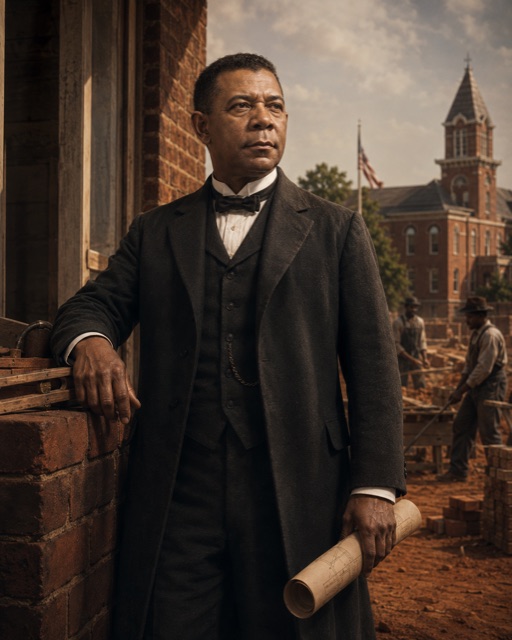
Self-Help and Institution Building · Memoir
Up From Slavery
by Booker T. Washington · The Builder of Tuskegee · Reconstruction and Jim Crow, 1856-1915
Washington's autobiography about slavery, education, Tuskegee, discipline, and institution building.
- Intermediate
- ~5 hr 45 min read
- 7 chapter guides
- Public domain
Start reading · Read the Chapter III guide free
Before the text
Editor's Prelude
What Work Can Build
Booker T. Washington grew up enslaved in Virginia. Freedom brought the chance to learn, but poverty and racial exclusion stood between him and an education. In this autobiography, published in 1901, he tells how that hunger for learning became a life spent teaching, building a school, and seeking support for Black education.
Washington wrote while leading Tuskegee, raising money, travelling, and speaking across the country. Personal memories sit beside speeches, letters, and accounts of the school’s work. Everyday details carry his argument: a clean room, a useful trade, or a well-run household can show what education has made possible. He values learning that joins thought, skill, and service to other people.
The story is also a public argument about race after emancipation. Washington’s faith in patience, economic independence, and cooperation made him influential. Yet the same faith puts a heavy burden on people facing injustice: they must prove their worth while others deny their rights. His hope is that disciplined work can create independence, institutions, and respect. The question running through the book is how much that achievement can change a society still divided by race.
The opening pages
Chapter I: A Slave Among Slaves
I was born a slave on a plantation in Franklin County, Virginia. I am not quite sure of the exact place or exact date of my birth, but at any rate I suspect I must have been born somewhere and at some time. As nearly as I have been able to learn, I was born near a cross-roads post-office called Hale’s Ford, and the year was 1858 or 1859. I do not know the month or the day. The earliest impressions I can now recall are of the plantation and the slave quarters—the latter being the part of the plantation where the slaves had their cabins.
My life had its beginning in the midst of the most miserable, desolate, and discouraging surroundings. This was so, however, not because my owners were especially cruel, for they were not, as compared with many others. I was born in a typical log cabin, about fourteen by sixteen feet square. In this cabin I lived with my mother and a brother and sister till after the Civil War, when we were all declared free.
Of my ancestry I know almost nothing. In the slave quarters, and even later, I heard whispered conversations among the coloured people of the tortures which the slaves, including, no doubt, my ancestors on my mother’s side, suffered in the middle passage of the slave ship while being conveyed from Africa to America. I have been unsuccessful in securing any information that would throw any accurate light upon the history of my family beyond my mother. She, I remember, had a half-brother and a half-sister. In the days of slavery not very much attention was given to family history and family records—that is, black family records. My mother, I suppose, attracted the attention of a purchaser who was afterward my owner and hers. Her addition to the slave family attracted about as much attention as the purchase of a new horse or cow. Of my father I know even less than of my mother. I do not even know his name. I have heard reports to the effect that he was a white man who lived on one of the near-by plantations. Whoever he was, I never heard of his taking the least interest in me or providing in any way for my rearing. But I do not find especial fault with him. He was simply another unfortunate victim of the institution which the Nation unhappily had engrafted upon it at that time.
Chapter guides · 7
Chapter III
Learning Begins with Work and Help
Washington reaches Hampton through hardship, but his education also depends on people who give him work, money, and care.
The road to Hampton
After hearing about Hampton’s school from two miners, Washington works in Mrs. Ruffner’s household and learns her strict standards of cleanliness. He sets out with help from his brother and older Black neighbours. A hotel turns him away because of his race. In Richmond, he sleeps under a sidewalk and earns money unloading a ship before reaching Hampton.
Admission is only the beginning
He earns admission by sweeping and dusting a room thoroughly. Miss Mackie gives him janitorial work to help pay for meals and lodging, while a donor pays his tuition. He learns daily habits as well as lessons. He comes to admire General Samuel C. Armstrong above any other man he has met. The chapter ends with the older students’ wish to help their communities and the teachers’ unselfish work. Washington hopes the South will come to value that service.
Chapter V
Freedom Needs Useful Education
Washington argues that education should help people earn a living as well as prepare them for public life.
The promise and mistakes of Reconstruction
Reconstruction was the effort to rebuild Southern society after the Civil War and slavery. Washington says political ambition often ran ahead of education and economic independence. He also faults the federal government for failing to provide general education after emancipation. He praises capable Black leaders and argues that voting rules must treat both races fairly.
Schooling and daily life
At a school in Washington, D.C., he finds academic learning without Hampton’s practical training. He worries that some people depend on government jobs or spend beyond their means. He closes with girls whose schooling raises their wants but not their ability to earn. His answer is to add practical skill to academic learning, so a girl can gain culture and also master useful work such as laundry.
Chapter VIII
Tuskegee Grows through Shared Effort
Washington and Olivia Davidson turn a small school into a practical project supported by local people.
Chapter XI
The School Becomes a Shared Home
Tuskegee’s students help make their surroundings and learn habits of cleanliness, trust, and care.
Chapter XIV
Atlanta Joins Cooperation to a Disputed Strategy
Washington’s famous speech brings praise and criticism, followed by his argument for fair voting rules.
Chapter XV
Shared Responsibility Makes Rest Possible
Washington explains how trusted colleagues keep Tuskegee working, then turns to the small pleasures of home.
Chapter XVII
Tuskegee’s Work Leads Back to Richmond
Washington measures the school by the people it has trained and closes with a welcome in the city where he once slept outside.
Questions readers ask
- How long does it take to read Up From Slavery?
- About 5 hr 45 min in total.
- How difficult is Up From Slavery?
- Intermediate. A long memoir; about 6 hours of reading.
- Can I read Up From Slavery for free?
- Up From Slavery is part of Nexus Premium, so reading it needs an account and a Premium subscription. The opening above and two chapter guides on this page are free to read.
- How many chapter guides are there?
- 7 chapter guides, written by the Nexus editors. Two open in full here; the rest show their opening line.
About Booker T. Washington
Booker T. Washington was an educator, author, orator, and founder of Tuskegee Institute. His life and writings focused on education, industrial training, self-help, racial uplift, and institution building under severe political constraint.
“How do you build strength under conditions designed to deny it?”
Washington is essential because his strategy shaped one of the central debates in American civil rights thought, especially in contrast with Du Bois.
Source text: public domain. Chapter guides: original Nexus writing. Up From Slavery is part of The Nexus Archive, guided Quests through the great works.