 The Nexus Archive
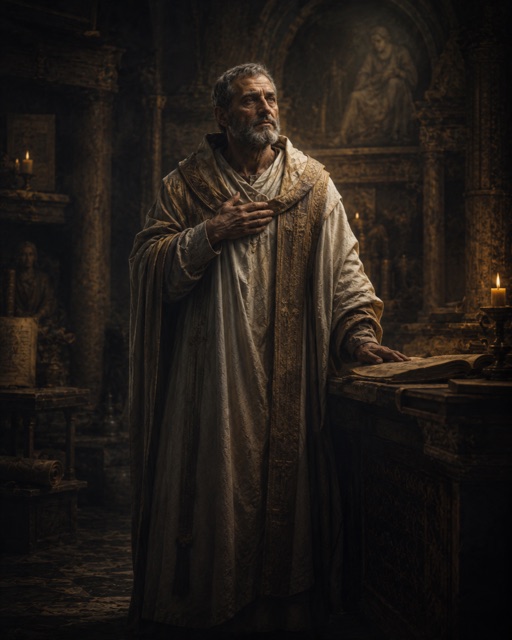
Christian Platonism · Theology
On the Trinity
by Augustine · The Confessor · Late Antiquity, 354-430
- Brutal
- ~13 hr 45 min read
- 67 chapter guides
- Public domain
Start reading · Read the Book I guide free
Before the text
Editor's Prelude
The Long Road Toward A Mystery
Augustine began On the Trinity around the year 400 and kept returning to it through years of episcopal pressure, controversy, and a Roman world coming apart. Before he considered it ready, incomplete books escaped into circulation. Rather than abandon them, he revised the argument and carried all fifteen books to the prayer with which the work finally ends.
The first half listens closely to Scripture's language about Father, Son, and Holy Spirit: equality and humility, sending and being sent, the eternal Word and the incarnate servant. The second half turns inward, searching knowledge, memory, understanding, and love for created traces of the God in whose image the mind is made. Every analogy advances the search, and every analogy must eventually confess its distance from God.
For Augustine, the search changes the person making it. Pride clouds judgment; love and honest correction help clear it. The effort to understand God becomes an effort to know the mind's weakness and to seek a truth it cannot possess or exhaust.
The opening pages
Book I: Chapters 1-3
Book I, Chapter 1. This Work is Written Against Those Who Sophistically Assail the Faith of the Trinity, Through Misuse of Reason. They Who Dispute Concerning God Err from a Threefold Cause. Holy Scripture, Removing What is False, Leads Us on by Degrees to Things Divine. What True Immortality is. We are Nourished by Faith, that We May Be Enabled to Apprehend Things Divine.
1. The following dissertation concerning the Trinity, as the reader ought to be informed, has been written in order to guard against the sophistries of those who disdain to begin with faith, and are deceived by a crude and perverse love of reason. Now one class of such men endeavor to transfer to things incorporeal and spiritual the ideas they have formed, whether through experience of the bodily senses, or by natural human wit and diligent quickness, or by the aid of art, from things corporeal; so as to seek to measure and conceive of the former by the latter. Others, again, frame whatever sentiments they may have concerning God according to the nature or affections of the human mind; and through this error they govern their discourse, in disputing concerning God, by distorted and fallacious rules. While yet a third class strive indeed to transcend the whole creation, which doubtless is changeable, in order to raise their thought to the unchangeable substance, which is God; but being weighed down by the burden of mortality, whilst they both would seem to know what they do not, and cannot know what they would, preclude themselves from entering the very path of understanding, by an over-bold affirmation of their own presumptuous judgments; choosing rather not to correct their own opinion when it is perverse, than to change that which they have once defended. And, indeed, this is the common disease of all the three classes which I have mentioned,—viz., both of those who frame their thoughts of God according to things corporeal, and of those who do so according to the spiritual creature, such as is the soul; and of those who neither regard the body nor the spiritual creature, and yet think falsely about God; and are indeed so much the further from the truth, that nothing can be found answering to their conceptions, either in the body, or in the made or created spirit, or in the Creator Himself. For he who thinks, for instance, that God is white or red, is in error; and yet these things are found in the body. Again, he who thinks of God as now forgetting and now remembering, or anything of the same kind, is none the less in error; and yet these things are found in the mind. But he who thinks that God is of such power as to have generated Himself, is so much the more in error, because not only does God not so exist, but neither does the spiritual nor the bodily creature; for there is nothing whatever that generates its own existence.
Chapter guides · 67
Book I: Chapters 1-3
Faith, inquiry, and correction
Book I, Chapters 1–3
The main argument
Augustine begins with three mistakes about God: imagining a body, projecting the changing human mind onto God, and inventing an impossible being that produces itself. Scripture leads weak minds toward a truth they cannot grasp at once. Faith begins that search; it does not end the need to think.
An argument open to correction
Augustine asks opponents and allies alike to correct him when they can. Different readers may need different explanations of the same truth. At the close, he would rather have a mistaken claim blamed on him than praised as though it were his real teaching.
Book I: Chapters 4-6
One God, inseparable action
Book I, Chapters 4–6
The main argument
Father, Son, and Holy Spirit are distinct, yet share one equal and undivided divine being. Particular appearances belong to particular persons: the Son becomes human; the Spirit appears as a dove. The work that brings about those appearances belongs to all three.
The Son and Spirit are uncreated
Augustine argues that the Word cannot be a creature because all created things were made through him. He then applies Scripture’s language of worship and God’s temple to the Spirit. The chapter ends by defending the Spirit’s divine status, rather than treating the Spirit as a servant within creation.
Book I: Chapters 7-8
Equal in divinity, humble in humanity
Book I, Chapters 7–8
Book I: Chapters 9-10
From visible presence to the sight of God
Book I, Chapters 9–10
Book I: Chapters 11-12
How one Christ receives different descriptions
Book I, Chapters 11–12
Book I: Chapter 13
The visible judge and the invisible good
Book I, Chapter 13
Book II: Preface and Chapters 1-2
Being from the Father does not mean being less
Book II, Preface and Chapters 1–2
Book II: Chapters 3-5
A mission reveals presence
Book II, Chapters 3–5
Book II: Chapters 6-9
A sign is not the divine being
Book II, Chapters 6–9
Book II: Chapters 10-12
Who spoke to Abraham and Lot?
Book II, Chapters 10–12
Book II: Chapters 13-16
The bush, the cloud, and Sinai
Book II, Chapters 13–16
Book II: Chapters 17-18
Moses’ hidden view and Daniel’s vision
Book II, Chapters 17–18
Book III: Preface and Chapters 1-4
Miracles and the chain of causes
Book III, Preface and Chapters 1–4
Book III: Chapters 5-8
Power over creation is not creative power
Book III, Chapters 5–8
Book III: Chapters 9-10
What makes a sign important?
Book III, Chapters 9–10
Book III: Chapter 11
Angels can speak in God’s name
Book III, Chapter 11
Book IV: Preface and Chapters 1-2
Grace answers human weakness
Book IV, Preface and Chapters 1–2
Book IV: Chapters 3-5
A single death and a double healing
Book IV, Chapters 3–5
Book IV: Chapters 6-10
One mediator gathers the many
Book IV, Chapters 6–10
Book IV: Chapters 11-15
Humility carries the soul home
Book IV, Chapters 11–15
Book IV: Chapters 16-19
Knowing the Creator and trusting a promise
Book IV, Chapters 16–19
Book IV: Chapters 20-21
Temporal missions, eternal relations
Book IV, Chapters 20–21
Book V: Chapters 1-6
Essence and relation
Book V, Chapters 1–6
Book V: Chapters 7-11
Necessary words and their limits
Book V, Chapters 7–11
Book V: Chapters 12-16
An eternal Gift given in time
Book V, Chapters 12–16
Book VI: Chapters 1-4
Does the Father need the Son to be wise?
Book VI, Chapters 1–4
Book VI: Chapters 5-10
Three persons do not make a larger God
Book VI, Chapters 5–10
Book VII: Chapters 1-2
Wisdom does not make the Father exist
Book VII, Chapters 1–2
Book VII: Chapters 3-4
Why say three persons?
Book VII, Chapters 3–4
Book VII: Chapters 5-6
An image without equality
Book VII, Chapters 5–6
Book VIII: Preface and Chapters 1-3
Good things and goodness itself
Book VIII, Preface and Chapters 1–3
Book VIII: Chapters 4-6
Loving a goodness not yet possessed
Book VIII, Chapters 4–6
Book VIII: Chapters 7-10
Lover, beloved, and love
Book VIII, Chapters 7–10
Book IX: Chapters 1-4
Mind, knowledge, and love
Book IX, Chapters 1–4
Book IX: Chapters 5-9
The inward word and the rule of truth
Book IX, Chapters 5–9
Book IX: Chapters 10-12
Why knowledge is offspring and love is not
Book IX, Chapters 10–12
Book X: Chapters 1-3
How can the mind seek itself?
Book X, Chapters 1–3
Book X: Chapters 4-8
Self-knowledge beneath bodily images
Book X, Chapters 4–8
Book X: Chapters 9-12
What doubt cannot remove
Book X, Chapters 9–12
Book XI: Chapters 1-2
Object, sight, and attention
Book XI, Chapters 1–2
Book XI: Chapters 3-5
A remembered object seen inwardly
Book XI, Chapters 3–5
Book XI: Chapters 6-7
Near purposes and final ends
Book XI, Chapters 6–7
Book XI: Chapters 8-11
Imagination rearranges remembered forms
Book XI, Chapters 8–11
Book XII: Chapters 1-6
Practical reason and contemplative wisdom
Book XII, Chapters 1–6
Book XII: Chapters 7-10
Women share the divine image
Book XII, Chapters 7–10
Book XII: Chapters 11-13
A fall enacted within one mind
Book XII, Chapters 11–13
Book XII: Chapters 14-15
Wisdom and knowledge need each other
Book XII, Chapters 14–15
Book XIII: Chapters 1-2
Faith concerns time and is known inwardly
Book XIII, Chapters 1–2
Book XIII: Chapters 3-7
Everyone wants happiness, but wills differ
Book XIII, Chapters 3–7
Book XIII: Chapters 8-12
Why the mediator became human
Book XIII, Chapters 8–12
Book XIII: Chapters 13-16
Righteousness defeats the devil’s claim
Book XIII, Chapters 13–16
Book XIII: Chapters 17-20
Christ joins temporal knowledge and eternal wisdom
Book XIII, Chapters 17–20
Book XIV: Chapters 1-4
The image outlasts faith
Book XIV, Chapters 1–4
Book XIV: Chapters 5-8
Knowledge can remain without present attention
Book XIV, Chapters 5–8
Book XIV: Chapters 9-13
The image is made for knowing God
Book XIV, Chapters 9–13
Book XIV: Chapters 14-16
Renewal restores the same image
Book XIV, Chapters 14–16
Book XIV: Chapters 17-19
Forgiveness begins a gradual healing
Book XIV, Chapters 17–19
Book XV: Chapters 1-3
A search gathered without being exhausted
Book XV, Chapters 1–3
Book XV: Chapters 4-6
Three attributes do not prove three persons
Book XV, Chapters 4–6
Book XV: Chapters 7-9
Each divine person knows and loves
Book XV, Chapters 7–9
Book XV: Chapters 10-11
The word before spoken language
Book XV, Chapters 10–11
Book XV: Chapters 12-14
Certainty, testimony, and the eternal Word
Book XV, Chapters 12–14
Book XV: Chapters 15-17
The unequal human word and the Spirit as love
Book XV, Chapters 15–17
Book XV: Chapters 18-19
The Gift that makes other gifts fruitful
Book XV, Chapters 18–19
Book XV: Chapters 20-23
A person has three faculties; God is not assembled
Book XV, Chapters 20–23
Book XV: Chapters 24-26
Generation and procession without a sequence
Book XV, Chapters 24–26
Book XV: Chapters 27-28
The search ends in prayer
Book XV, Chapters 27–28
Questions readers ask
- How long does it take to read On the Trinity?
- About 13 hr 45 min in total.
- How difficult is On the Trinity?
- Brutal. A long work of theology; about 14 hours of reading.
- Can I read On the Trinity for free?
- On the Trinity is part of Nexus Premium, so reading it needs an account and a Premium subscription. The opening above and two chapter guides on this page are free to read.
- How many chapter guides are there?
- 67 chapter guides, written by the Nexus editors. Two open in full here; the rest show their opening line.
About Augustine
Augustine was born in Roman North Africa, pursued education and ambition across the late Roman world, and converted to Christianity after years of intellectual and spiritual conflict. As bishop of Hippo, he became one of Christianity's most influential figures.
“Why do I want what destroys me?”
Augustine helps invent the inner life as a battlefield of love, memory, guilt, and divine longing.
Source text: public domain. Chapter guides: original Nexus writing. On the Trinity is part of The Nexus Archive, guided Quests through the great works.