 The Nexus Archive
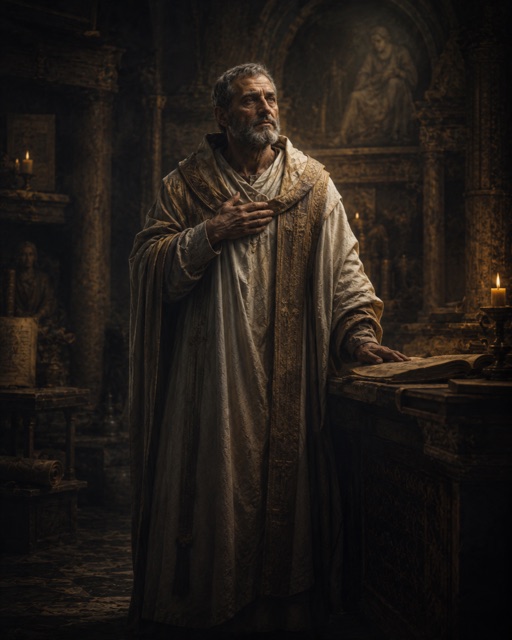
Christian Platonism · Theology
Confessions
by Augustine · The Confessor · Late Antiquity, 354-430
A life examined through memory, desire, conversion, and grace.
- Advanced
- c. 397 CE
- ~8 hr 30 min read
- 58 chapter guides
- Public domain
Start reading · Read the Book I guide free
Before the text
Editor's Prelude
A Life Turned Into Prayer
Augustine wrote Confessions after the dramatic years it remembers: a restless youth in North Africa, a career built on rhetoric, the pull of Manichaeism, a mother's long hope, and the conversion in Milan that would make him one of Christianity's defining voices. He does not look back to celebrate the man he became. He looks back to ask how grace found a man who kept mistaking achievement, pleasure, and admiration for a home.
This is not a neutral autobiography. Augustine addresses God throughout, so every scene holds two selves at once: the young Augustine living through desire, ambition, grief, and delay; and the older bishop who can finally name what was happening beneath them. Monica, Ambrose, the garden, the stolen pears, a dead friend, and the restless mind all become part of one long examination of what a human heart loves when it says it is searching for happiness.
The first nine Books follow a life through conversion and baptism. The last four deepen rather than depart from it, turning to memory, time, creation, Scripture, and rest. Augustine begins with a life and ends by asking what it means for any created thing to find its place before God.
The opening pages
Book I: Praise, Infancy, and First Memory
Great art Thou, O Lord, and greatly to be praised; great is Thy power, and Thy wisdom infinite. And Thee would man praise; man, but a particle of Thy creation; man, that bears about him his mortality, the witness of his sin, the witness that Thou resistest the proud: yet would man praise Thee; he, but a particle of Thy creation. Thou awakest us to delight in Thy praise; for Thou madest us for Thyself, and our heart is restless, until it repose in Thee. Grant me, Lord, to know and understand which is first, to call on Thee or to praise Thee? and, again, to know Thee or to call on Thee? for who can call on Thee, not knowing Thee? for he that knoweth Thee not, may call on Thee as other than Thou art. Or, is it rather, that we call on Thee that we may know Thee? but how shall they call on Him in whom they have not believed? or how shall they believe without a preacher? and they that seek the Lord shall praise Him: for they that seek shall find Him, and they that find shall praise Him. I will seek Thee, Lord, by calling on Thee; and will call on Thee, believing in Thee; for to us hast Thou been preached. My faith, Lord, shall call on Thee, which Thou hast given me, wherewith Thou hast inspired me, through the Incarnation of Thy Son, through the ministry of the Preacher.
And how shall I call upon my God, my God and Lord, since, when I call for Him, I shall be calling Him to myself? and what room is there within me, whither my God can come into me? whither can God come into me, God who made heaven and earth? is there, indeed, O Lord my God, aught in me that can contain Thee? do then heaven and earth, which Thou hast made, and wherein Thou hast made me, contain Thee? or, because nothing which exists could exist without Thee, doth therefore whatever exists contain Thee? Since, then, I too exist, why do I seek that Thou shouldest enter into me, who were not, wert Thou not in me? Why? because I am not gone down in hell, and yet Thou art there also. For if I go down into hell, Thou art there. I could not be then, O my God, could not be at all, wert Thou not in me; or, rather, unless I were in Thee, of whom are all things, by whom are all things, in whom are all things? Even so, Lord, even so. Whither do I call Thee, since I am in Thee? or whence canst Thou enter into me? for whither can I go beyond heaven and earth, that thence my God should come into me, who hath said, I fill the heaven and the earth.
Read it in a Quest
A passage through conversion, disciplined reason, and the restless heart before faith.
Chapter guides · 58
Book I: Praise, Infancy, and First Memory
Praise Before Memory
Augustine begins by turning autobiography into prayer.
Praise and dependence
Augustine opens not with facts about himself, but with praise, need, and bewilderment before God. Even infancy becomes something he can only understand by confessing dependence.
A life received
Augustine cannot remember his infancy. He draws on what others tell him and what he sees in babies now. Their helpless bodies do not, for him, prove innocent wills: jealousy and anger are already visible. He thanks God for the life and care he received before he could understand them. Then he sets that forgotten age aside: if he was conceived in sin, when was he ever guiltless?
Book I: Boyhood and Delayed Baptism
A Child Learns Desire
Augustine moves from infancy to boyhood, school, punishment, and deferred baptism.
Words and punishment
Augustine learns speech by watching people name things and gesture. At school he fears beatings, while adults laugh at the distress that makes him pray. He prefers games to lessons and sees grown people pursuing prizes of their own.
Baptism postponed
During a dangerous illness he asks for baptism, and Monica prepares it. When he recovers, it is put off because sins after baptism are thought more serious. Looking back, he questions a delay that left him without the healing he had asked for. Monica, he says, foresaw the temptations ahead and chose to expose the soft clay to them rather than the finished cast.
Book I: Schooling, Stories, and Misordered Praise
Learning To Love The Wrong Glory
Augustine attacks the school culture that taught eloquence while neglecting truth.
Book I: Wit, Grammar, and Gratitude
The Child Was Gifted And Misled
Book I closes with Augustine thanking God for gifts he misused.
Book II: Youthful Desire and Idleness
Desire And The Fear Of Disapproval
Augustine remembers desire growing in an idle year at home.
Book II: Pear Tree, Companionship, and Mercy
Theft, Companionship, and Mercy
The pear tree becomes Augustine's test case for crooked love and the social pull of sin.
Book III: Carthage, Theater, and the Search
Carthage And The Love Of Feeling
Augustine enters Carthage, where desire, theater, ambition, and philosophy collide.
Book III: Manichee Snares and False Substance
False Answers To Real Hunger
Manichee teaching leaves Augustine hungry for the truth it promises.
Book III: Moral Law, Scripture, and Monica's Hope
Custom, Scripture, and Monica's Hope
Augustine moves from moral confusion to the hope carried by Monica's prayers.
Book IV: Teaching, Astrology, and False Wisdom
Brilliance Without Conversion
Augustine teaches rhetoric, consults astrology, and remains inside false wisdom.
Book IV: Friendship, Death, and Grief
A Friend Becomes A Wound
The death of a friend exposes how fragile misordered love can be.
Book IV: Turn Love Back to God
Created Beauty Must Point Beyond Itself
Augustine turns from grief to the problem of loving changeable things.
Book IV: Fame, Beauty, and Empty Learning
The Proud Mind Stays Hungry
Book IV ends with fame, beauty, Aristotle’s categories, and liberal arts that do not save.
Book V: Manichees, Science, and Empty Knowledge
Knowing The Stars Is Not Knowing God
Augustine contrasts natural knowledge with piety and truth.
Book V: Faustus and Disappointment
The Teacher Cannot Answer
Faustus impresses Augustine as a speaker but disappoints him as a guide.
Book V: Rome, Illness, and Monica's Grief
Flight To Rome, Mercy In Illness
Augustine deceives Monica, sails to Rome, and nearly dies there.
Book V: Skepticism, Ambrose, and a New Hearing
A New Way To Hear Scripture
Augustine reaches Milan and begins listening to Ambrose.
Book VI: Monica, Ambrose, and Catholic Scripture
The Door Opens Slowly
Book VI begins with Monica in Milan and Augustine learning to hear the Church differently.
Book VI: Ambition, Alypius, and Friendship
Friends In The Same Maze
Augustine’s friendships reveal both support and shared captivity.
Book VI: Marriage, Plans, and Divided Desire
Plans That Cannot Save
Marriage plans, shared-life schemes, and desire expose Augustine’s divided will.
Book VII: God Beyond Bodies
God Is Not A Body
Augustine struggles to imagine God without material shape.
Book VII: Evil, Astrology, and Free Will
The Problem Of Evil Tightens
Astrology falls away, but the question of evil remains.
Book VII: Platonist Books and the Word
The Platonists Lift The Mind
Augustine finds language for incorporeal truth, but not yet the humility of Christ.
Book VII: The Inward Ascent
Seeing But Not Yet Dwelling
Augustine enters inwardly and glimpses truth above the mind.
Book VII: Christ the Mediator and Paul
The Mediator Gives The Way
Book VII closes by turning from Platonist ascent to Christ and Paul.
Book VIII: Victorinus and the Divided Will
Conversion Becomes Possible
Victorinus's story makes public conversion imaginable, then Augustine names the divided will holding him back.
Book VIII: Pontitianus and Antony
Other People Have Already Chosen
Pontitianus tells stories that make Augustine’s delay unbearable.
Book VIII: The Last Inner Battle and Take Up and Read
The Will At The Breaking Point
Augustine reaches the final inner struggle and the garden conversion.
Book IX: Leaving the Chair of Rhetoric
A Quiet Exit From Public Ambition
After conversion, Augustine leaves his rhetorical career without spectacle.
Book IX: Psalms, Healing, and Baptism
Psalms And New Life
Augustine’s new life is formed by Scripture, prayer, healing, and baptism.
Book IX: Milan, Monica, and Holy Friendship
Monica In The Church’s Life
Augustine turns toward Monica’s story and the community around her.
Book IX: Ostia and Monica's Last Request
The Window At Ostia
Augustine and Monica glimpse the life beyond time.
Book IX: Grief, Prayer, and Monica's Rest
Grief Learns To Pray
Book IX closes with Monica’s death and Augustine’s prayer for her.
Book X: Confessing What I Am Now
The Confession Turns Present
Book X changes the question from what Augustine was to what Augustine is now.
Book X: What Do I Love When I Love God?
What Love Is Looking For
Augustine asks what he loves when he loves God.
Book X: The Vast Palace of Memory
The Vast Palace Of Memory
Augustine enters memory as a huge inner world.
Book X: Memory and Forgetfulness
The Mind Cannot Hold Itself Completely
Augustine presses into memory, forgetfulness, and the strange limits of self-knowledge.
Book X: Happiness, Truth, and the Search for God
Everyone Wants Happiness
Augustine connects memory to the universal desire for happiness and truth.
Book X: The Weight of Temptation
Temptation After Conversion
Augustine begins confessing the temptations that remain after baptism.
Book X: Food, Music, and the Senses
The Senses As Gifts And Tests
Augustine examines food, fragrance, music, sight, and the difficulty of enjoying them rightly.
Book X: Curiosity and Praise
Curiosity And The Need To Be Seen
Augustine moves from sensory temptation to curiosity, pride, and love of praise.
Book X: The True Mediator
The Only Way Through
Book X ends with Christ as the true mediator.
Book XI: Prayer Before Genesis
Prayer Before The First Verse
Augustine begins Book XI by asking God to open Genesis.
Book XI: Before Creation and Before Time
No Then Before Time
Augustine answers the question of what God was doing before creation.
Book XI: What Is Time?
What Is Time?
Augustine names the mystery everyone uses and no one easily explains.
Book XI: Measuring What Passes
Measuring Time In The Mind
Augustine rejects the idea that time is simply the motion of bodies.
Book XI: Memory, Expectation, and Eternity
A Soul Stretched In Time
Book XI closes with the mind distended across past, present, and future.
Book XII: Formless Matter and the Heaven of Heavens
Creation Before Shape
Augustine begins Book XII with formless matter and the heaven of heavens.
Book XII: Creation Heard Inwardly and Scripture's Depth
The Inner Ear Of Creation
Augustine listens for what Genesis teaches about time, change, created being, and Scripture's depth.
Book XII: Created Wisdom and Created Matter
Created Light Is Not God
Augustine distinguishes God from even the highest created wisdom.
Book XII: Words, Meaning, and Many Truths
Many Meanings, One Truth
Augustine refuses to fight over interpretations that can all be true.
Book XII: Charity and the Fullness of Scripture
Charity Governs the Reading
Book XII closes by making humility the rule for hard sacred texts.
Book XIII: Invocation and the Spirit
Creation Needs No Reward
Book XIII begins by returning creation to God's free goodness.
Book XIII: The Fall, the Deep, and Scripture
The Deep and the Lift of the Spirit
Augustine reads the waters and the deep as images of spiritual need.
Book XIII: Firmament, Waters, and Witness
The Firmament of Scripture
Augustine sees Scripture as a sheltering authority over human weakness.
Book XIII: Living Creatures and Spiritual Judgment
Creatures, Sacraments, and Judgment
Augustine turns Genesis into a language for the life of the Church.
Book XIII: Increase, Gifts, and Fruit
Fruit, Gifts, and Right Giving
Augustine distinguishes outward gifts from the inward fruit of love.
Book XIII: Seeing That It Is Good and Sabbath Rest
Seeing That It Is Good
Augustine returns to God's judgment that creation is good, then ends in Sabbath rest.
Questions readers ask
- How long does it take to read Confessions?
- About 8 hr 30 min in total.
- How difficult is Confessions?
- Advanced. A long work of theology; about 9 hours of reading.
- Can I read Confessions for free?
- Confessions is part of Nexus Premium, so reading it needs an account and a Premium subscription, and completing an earlier Quest's Mastery. The opening above and two chapter guides on this page are free to read.
- How many chapter guides are there?
- 58 chapter guides, written by the Nexus editors. Two open in full here; the rest show their opening line.
About Augustine
Augustine was born in Roman North Africa, pursued education and ambition across the late Roman world, and converted to Christianity after years of intellectual and spiritual conflict. As bishop of Hippo, he became one of Christianity's most influential figures.
“Why do I want what destroys me?”
Augustine helps invent the inner life as a battlefield of love, memory, guilt, and divine longing.
Source text: public domain. Chapter guides: original Nexus writing. Confessions is part of The Nexus Archive, guided Quests through the great works.