 The Nexus Archive
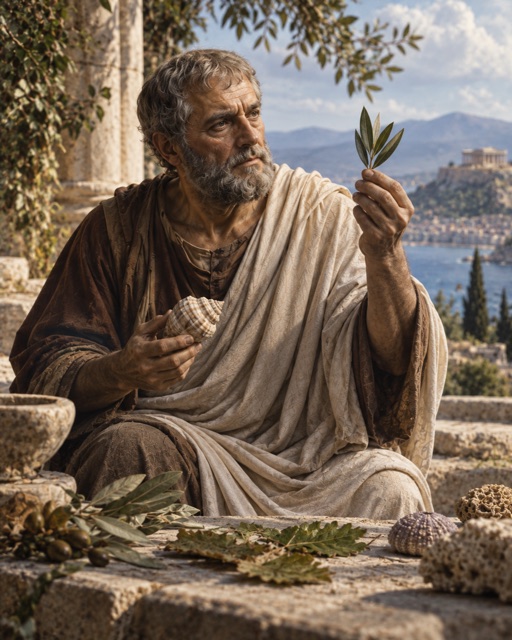
Aristotelianism · Treatise
Politics
by Aristotle · The Architect of Causes · Classical Greece, 384-322 BC
- Advanced
- ~7 hr 15 min read
- 36 chapter guides
- Public domain
Start reading · Read the Introduction guide free
Before the text
Editor's Prelude
Who Shares the Good Life?
Aristotle’s Politics belongs with the Ethics: it asks what kind of shared life can make human flourishing possible. Its world is the Greek city, where disputes over property, citizenship, war, and public office could turn neighbours into enemies. The philosopher’s inquiry has to answer both the hope for a worthy common life and the danger that competing groups will tear a community apart.
A lawgiver, in this account, does more than assign offices and settle disputes. Laws help form people’s habits, their expectations of one another, and their sense of what deserves honour. Aristotle tests proposals for an ideal city against the difficulties of living together. He also studies imperfect governments closely enough to ask how they might survive. The best arrangement imaginable and the best arrangement a particular people can sustain are different questions.
The freedom he prizes is unequally available. His citizens deliberate, judge, and take turns governing; their independence rests on work done by others. His defence of slavery and his restrictions on women and workers belong inside this account of the good life. They expose a central difficulty in it: a community may cultivate justice among its members while denying many of the people who sustain it a share in that membership.
This edition presents William Ellis’s translation and opens with a later introduction by A. D. Lindsay. Lindsay is a separate voice, explaining Aristotle’s connection between ethics and politics while challenging the exclusions on which his ideal city depends.
The opening pages
Book I: City and Household
Chapter I
As we see that every city is a society, and every society is established for some good purpose; for an apparent [Bekker 1252a] good is the spring of all human actions; it is evident that this is the principle upon which they are every one founded, and this is more especially true of that which has for its object the best possible, and is itself the most excellent, and comprehends all the rest. Now this is called a city, and the society thereof a political society; for those who think that the principles of a political, a regal, a family, and a herile government are the same are mistaken, while they suppose that each of these differ in the numbers to whom their power extends, but not in their constitution: so that with them a herile government is one composed of a very few, a domestic of more, a civil and a regal of still more, as if there was no difference between a large family and a small city, or that a regal government and a political one are the same, only that in the one a single person is continually at the head of public affairs; in the other, that each member of the state has in his turn a share in the government, and is at one time a magistrate, at another a private person, according to the rules of political science. But now this is not true, as will be evident to any one who will consider this question in the most approved method. As, in an inquiry into every other subject, it is necessary to separate the different parts of which it is compounded, till we arrive at their first elements, which are the most minute parts thereof; so by the same proceeding we shall acquire a knowledge of the primary parts of a city and see wherein they differ from each other, and whether the rules of art will give us any assistance in examining into each of these things which are mentioned.
Chapter II
Now if in this particular science any one would attend to its original seeds, and their first shoot, he would then as in others have the subject perfectly before him; and perceive, in the first place, that it is requisite that those should be joined together whose species cannot exist without each other, as the male and the female, for the business of propagation; and this not through choice, but by that natural impulse which acts both upon plants and animals also, for the purpose of their leaving behind them others like themselves. It is also from natural causes that some beings command and others obey, that each may obtain their mutual safety; for a being who is endowed with a mind capable of reflection and forethought is by nature the superior and governor, whereas he whose excellence is merely corporeal is formed to be a slave; whence it follows that the different state of master [1252b] and slave is equally advantageous to both. …
Chapter guides · 36
Introduction
Lindsay’s Argument with Aristotle
A. D. Lindsay introduces the Politics by tracing the tension between its ideal city and its study of actual power.
A community teaches its members
Lindsay connects the Politics with the Ethics: the good life depends on the society in which people learn to live. His Greek lawgiver shapes a constitution understood as a way of life, not merely a set of offices. Education therefore belongs at the centre of political inquiry.
The limits of the ideal
Lindsay also disputes Aristotle’s conclusions. The ideal citizen’s leisure depends on workers denied citizenship, while the defence of natural slavery treats people’s present condition as permanent. His introduction asks whether Aristotle’s account of a common good can accommodate the conflicting interests and unequal power that his political observations reveal. Lindsay says Aristotle’s idealism and realism are never reconciled. He ends by arguing that calling people natural slaves turns their present limitations into a permanent barrier to citizenship.
Book I: City and Household
The City and Its Unequal Parts
Aristotle connects political life with shared judgments of justice, then argues that some people are naturally fitted to serve others.
Living together, living well
The household supplies daily needs; the city completes a larger association capable of sustaining a good life. Speech matters because it allows people to distinguish the useful from the harmful and the just from the unjust. In this account, a city develops capacities that an isolated person cannot exercise alone.
A hierarchy called natural
Aristotle distinguishes political rule from mastery, yet places slavery inside his account of the household. He argues that some people possess bodily strength without the reasoning power to direct their own lives. This is his justification for treating a person as another’s instrument. He acknowledges that actual bodies and souls do not always fit the distinction he claims nature makes. He concludes that some are slaves by nature and that enslaving them is just when it benefits them.
Book I: Slavery, Property, and Exchange
Conquest, Possession, and Use
Aristotle questions whether victory can justify enslavement and separates household provision from the pursuit of money.
Book I: Wealth and Family Rule
Wealth Has a Purpose
Aristotle limits acquisition by the needs of a good life, then assigns unequal forms of authority and virtue within the household.
Book II: Plato's Common City
How Much Unity Can a City Bear?
Aristotle argues that Plato’s common families could weaken the affection and responsibility they are meant to extend.
Book II: Laws and Property
Private Possessions, Shared Use
Aristotle defends property held separately and used generously, then asks whether Plato’s laws can support the people they prescribe for.
Book II: Phaleas and Hippodamus
Property Is Only Part of the Problem
Aristotle challenges Phaleas’s remedy for civic conflict and introduces Hippodamus’s plan for a divided city.
Book II: The Spartan Constitution
Power Behind the Plan
Aristotle tests Hippodamus’s divisions, weighs the risks of changing laws, and examines Sparta’s distribution of power.
Book II: Crete and Carthage
Who Can Afford to Govern?
The comparison of Sparta, Crete, and Carthage tests whether a city’s institutions sustain participation or turn power into a possession.
Book II: Lawgivers
Solon’s Laws and Their Afterlife
Aristotle distinguishes what a lawgiver intended from the changes later generations made possible.
Book III: Citizen and City
The Citizen Question
Aristotle defines citizenship through participation in judgment and office, then separates civic excellence from personal goodness.
Book III: Constitutions and Justice
For Whose Benefit?
Aristotle separates constitutions serving a common good from those serving only the people who hold power.
Book III: Who Should Rule?
The Judgment of the Many
Aristotle tests rival claims to authority and asks whether citizens can judge well together without each being an expert.
Book III: Merit, Ostracism, and Kingship
Excellence and Equal Rule
Aristotle asks which advantages justify political authority and whether exceptional virtue can fit within equal citizenship.
Book III: Forms of Kingship
Kingship Is Many Things
Aristotle distinguishes limited kingship from absolute rule and asks what law can protect against human passion.
Book III: The Best Constitution
The Exception to Equal Rule
Aristotle weighs shared judgment against personal rule, then restates the exceptional case in which he considers kingship just.
Book IV: Varieties of Rule
The Constitution a City Can Sustain
Aristotle broadens political inquiry from the best imaginable government to the forms that different communities can actually maintain.
Book IV: Democracy and Oligarchy
Who Rules When the Law Does Not?
Aristotle distinguishes forms of democracy and oligarchy by participation, wealth, and the authority of law.
Book IV: The Middle Constitution
The Middle Holds the Balance
Aristotle connects a mixture of institutions with the strength of citizens who are neither very rich nor very poor.
Book IV: Preserving the Balance
An Open Door Is Not Equal Access
Aristotle shows how attendance rules and practical costs can concentrate power even when participation is formally open.
Book IV: Offices and Courts
Institutions Decide Access
The distribution of offices and judicial powers determines which citizens can act for the city.
Book V: Why Regimes Change
Rival Measures of Justice
Aristotle traces constitutional conflict to competing claims about equality, honour, and the share of power people believe they deserve.
Book V: Causes of Revolution
A Private Quarrel Becomes Public
Aristotle follows personal disputes into factional conflict, then examines the pressures that overturn democracies and oligarchies.
Book V: Saving Constitutions
Keeping Public Power Public
Aristotle links constitutional survival with restraint, honest administration, and protection for people outside the ruling group.
Book V: Oligarchy, Democracy, and Tyranny
What Turns Subjects Against a Ruler?
Aristotle moves from the discipline that preserves constitutions to the injuries and ambitions that provoke attacks on monarchs.
Book V: Preserving Monarchy
Two Ways to Preserve a Tyranny
Aristotle contrasts the restraint that sustains kingship with two opposing methods of maintaining coercive rule.
Book V: Fortune and Regime Life
Constitutions Do Not Follow One Cycle
Aristotle compares the duration of tyrannies and disputes Plato’s proposed sequence of political decline.
Book VI: Democratic Institutions
Democracy Depends on Its People
Aristotle examines democratic freedom and the effect of occupation, leisure, and settlement on participation.
Book VI: Oligarchic Institutions
Making Government Last
Aristotle connects constitutional stability with secure livelihoods, measured participation, and clearly assigned public duties.
Book VII: The Good State
What Makes a City Happy?
Aristotle measures a city by the good life it makes possible, rather than its wealth or power over neighbours.
Book VII: Territory and Citizenship
A City Large Enough to Know
Aristotle gives his best city limits of population and territory, then distinguishes the people it needs from those it admits as members.
Book VII: City Design and Common Life
Who Has Leisure in the Best City?
Aristotle’s plans for land, common meals, and public spaces rest on a sharp division between citizens and those who work for them.
Book VII: Happiness and Education
Learning How to Live in Peace
Aristotle argues that education must prepare citizens for the ends of a good life, not only for the struggles that secure it.
Book VII: Birth, Childhood, and Formation
The Legislator Enters the Household
Aristotle extends political authority into marriage, reproduction, and the earliest experiences of children.
Book VIII: Education and Leisure
Leisure Needs Education
Aristotle makes education a public responsibility and asks how music can form judgment as well as give pleasure.
Book VIII: Music and Character
Music Trains Judgment
Aristotle distinguishes learning to judge music from performing for an audience, and gives different kinds of music different purposes.
Questions readers ask
- How long does it take to read Politics?
- About 7 hr 15 min in total.
- How difficult is Politics?
- Advanced. A long treatise; about 7 hours of reading.
- Can I read Politics for free?
- Politics is part of Nexus Premium, so reading it needs an account and a Premium subscription. The opening above and two chapter guides on this page are free to read.
- How many chapter guides are there?
- 36 chapter guides, written by the Nexus editors. Two open in full here; the rest show their opening line.
About Aristotle
Aristotle studied at Plato's Academy, tutored the young Alexander the Great, and founded his own school in Athens. His work ranged across logic, ethics, politics, biology, rhetoric, and metaphysics, creating systems that shaped scholarship for centuries.
“What is this thing for?”
Aristotle becomes the operating system for logic, ethics, biology, politics, and medieval scholastic thought.
Source text: public domain. Chapter guides: original Nexus writing. Politics is part of The Nexus Archive, guided Quests through the great works.