 The Nexus Archive
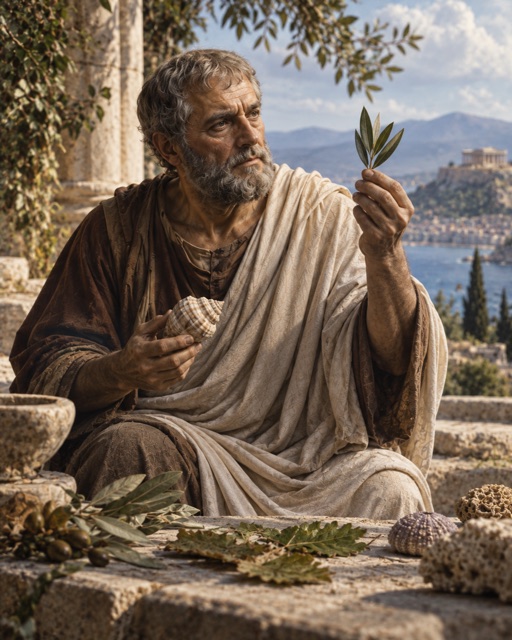
Aristotelianism · Treatise
Poetics
by Aristotle · The Architect of Causes · Classical Greece, 384-322 BC
A compact account of tragedy, imitation, plot, and why art can clarify human action.
- Intermediate
- c. 335 BCE
- ~1 hr 15 min read
- 8 chapter guides
- Public domain
Start reading · Read the Sections I-III guide free
Before the text
Editor's Prelude
What Holds a Story Together
In a Greek theatre, an audience could know the story of Oedipus and still be moved by its unfolding. Aristotle, a philosopher of the fourth century BC, takes that experience as something worth explaining. The poet works with stories people recognise, yet the way an action is shaped can make familiar suffering felt anew.
Drama belonged to the civic and religious festivals of Greek cities. Homer’s epics and the plays of Aeschylus, Sophocles and Euripides give Aristotle a shared world of examples. His idea of poetry reaches beyond verse: he places it beside painting, music and dance as an art of representing people and actions. The pleasure of recognising a likeness matters to him, as does the difficult pleasure of witnessing a disaster on stage.
The surviving treatise is terse, and many of the plays it mentions have been lost. It moves quickly between large claims and small practical judgments, sometimes leaving a question unresolved. Its central concern is tangible: a work has to hold together. Beautiful speeches, convincing characters and striking effects can each succeed on their own while the play they belong to fails.
The opening pages
Sections I-III: The Kinds of Imitation
I
I propose to treat of Poetry in itself and of its various kinds, noting the essential quality of each; to inquire into the structure of the plot as requisite to a good poem; into the number and nature of the parts of which a poem is composed; and similarly into whatever else falls within the same inquiry. Following, then, the order of nature, let us begin with the principles which come first.
Epic poetry and Tragedy, Comedy also and Dithyrambic poetry, and the music of the flute and of the lyre in most of their forms, are all in their general conception modes of imitation. They differ, however, from one another in three respects,—the medium, the objects, the manner or mode of imitation, being in each case distinct.
For as there are persons who, by conscious art or mere habit, imitate and represent various objects through the medium of colour and form, or again by the voice; so in the arts above mentioned, taken as a whole, the imitation is produced by rhythm, language, or 'harmony,' either singly or combined.
Thus in the music of the flute and of the lyre, 'harmony' and rhythm alone are employed; also in other arts, such as that of the shepherd's pipe, which are essentially similar to these. In dancing, rhythm alone is used without 'harmony'; for even dancing imitates character, emotion, and action, by rhythmical movement.
There is another art which imitates by means of language alone, and that either in prose or verse—which, verse, again, may either combine different metres or consist of but one kind—but this has hitherto been without a name. For there is no common term we could apply to the mimes of Sophron and Xenarchus and the Socratic dialogues on the one hand; and, on the other, to poetic imitations in iambic, elegiac, or any similar metre. People do, indeed, add the word 'maker' or 'poet' to the name of the metre, and speak of elegiac poets, or epic (that is, hexameter) poets, as if it were not the imitation that makes the poet, but the verse that entitles them all indiscriminately to the name. Even when a treatise on medicine or natural science is brought out in verse, the name of poet is by custom given to the author; and yet Homer and Empedocles have nothing in common but the metre, so that it would be right to call the one poet, the other physicist rather than poet. On the same principle, even if a writer in his poetic imitation were to combine all metres, as Chaeremon did in his Centaur, which is a medley composed of metres of all kinds, we should bring him too under the general term poet. So much then for these distinctions.
Chapter guides · 8
Sections I-III
Imitation Has Kinds
Aristotle distinguishes the means of representation, the people represented, and the way their actions are presented.
Three ways to distinguish the arts
Aristotle starts by treating poetry as imitation. Different arts imitate through different media, objects, and modes: rhythm, language, harmony, noble or base characters, narration, or dramatic action.
Verse does not settle the question
Homer and Empedocles write in the same metre, but Aristotle calls one a poet and the other a writer about nature. Socratic dialogues, though written in prose, also represent people speaking and acting. What matters in this classification is the kind of representation a work makes.
One poet can belong beside different others
Sophocles resembles Homer in portraying people as better than they are, and Aristophanes in presenting characters who act before us. Aristotle then reports the Dorians’ claims to the invention of drama. They trace comedy’s name to their word for villages, saying that performers wandered between villages after being excluded from the city, and appeal to their word for doing to support the name drama. Local language becomes their evidence for the priority they claim.
Sections IV-V
Poetry Grows from Human Nature
Pleasure in imitation helps Aristotle explain poetry’s beginnings; the histories of its forms are less equally known.
A likeness can please when its subject does not
A corpse or an unpleasant animal may distress us, yet its image can give pleasure. Aristotle locates that pleasure in learning and recognition. If the original is unfamiliar, the workmanship or colour may please instead. He joins this impulse to imitate with a natural feeling for rhythm and harmony.
The record is clearer for tragedy
Aristotle traces poetic forms back to improvisation, crediting Aeschylus with a second actor and Sophocles with a third. Comedy’s early changes are harder to trace because it was not initially taken seriously. He defines the comic through a particular kind of ugliness: a defect that causes neither pain nor destruction.
Epic and tragedy differ in their reach
Both represent people of a higher type. Epic tells its story in a single metre, while tragedy enacts its story and uses more varied means. Aristotle also observes that tragedy generally tries to keep its action within a day, or a little longer. He describes a practice that developed over time, acknowledging that early tragedy allowed the same freedom as epic.
Sections VI-VIII
Plot Holds Tragedy Together
Aristotle identifies tragedy's parts and makes plot the central one.
Sections IX-XI
Surprise Must Still Make Sense
Poetry concerns what could happen; a strong plot makes its surprising events grow from one another.
Sections XII-XV
Pity, Fear and Character
Aristotle asks whose misfortune moves us, how knowledge changes a terrible deed, and what makes a character convincing.
Sections XVI-XIX
Constructing the Action
Aristotle moves from kinds of recognition to the practical work of imagining, arranging and completing a play.
Sections XX-XXII
Clarity and Distinction
The Poetics pauses over diction, metaphor, and the texture of style.
Sections XXIII-XXVI
Epic and Tragedy Compared
Aristotle examines epic’s freedoms, the fairness of critical objections, and tragedy’s claim to the higher rank.
Questions readers ask
- How long does it take to read Poetics?
- About 1 hr 15 min in total.
- How difficult is Poetics?
- Intermediate. A mid-length treatise; about an hour of reading.
- Which translation is this?
- The S. H. Butcher translation from the Ancient Greek. The text follows The Poetics of Aristotle.
- Can I read Poetics for free?
- Poetics is part of Nexus Premium, so reading it needs an account and a Premium subscription. The opening above and two chapter guides on this page are free to read.
- How many chapter guides are there?
- 8 chapter guides, written by the Nexus editors. Two open in full here; the rest show their opening line.
About Aristotle
Aristotle studied at Plato's Academy, tutored the young Alexander the Great, and founded his own school in Athens. His work ranged across logic, ethics, politics, biology, rhetoric, and metaphysics, creating systems that shaped scholarship for centuries.
“What is this thing for?”
Aristotle becomes the operating system for logic, ethics, biology, politics, and medieval scholastic thought.
Source text: public domain. Chapter guides: original Nexus writing. Poetics is part of The Nexus Archive, guided Quests through the great works.