 The Nexus Archive
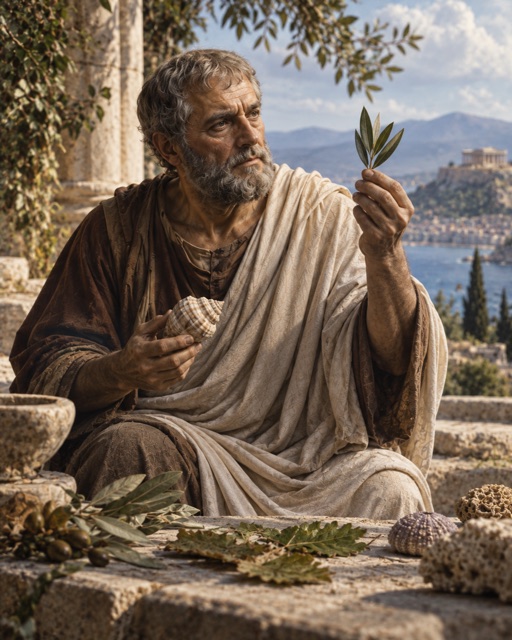
Aristotelianism · Treatise
Physics
by Aristotle · The Architect of Causes · Classical Greece, 384-322 BC
Aristotle's eight-book Physics investigates nature, cause, change, place, time, continuity, and motion.
- Brutal
- ~6 hr 30 min read
- 7 chapter guides
- Public domain
Start reading · Read the Book I, Chapter 9 guide free
Before the text
Editor's Prelude
What It Means for Nature to Move
The Physics studies the familiar natural world: growing plants, falling bodies, and changes in heat or colour. Seeing a change happen is one kind of knowledge. Explaining what makes it possible is another. Aristotle starts from the whole that we recognize and works toward its principles.
These eight books are an inquiry built from questions, objections, and careful distinctions. Motion often means more than travel from place to place. Growth and changes in quality belong to the inquiry too. A builder at work and a finished house help Aristotle separate an active process from its completed result.
Behind the examples lies a large problem. Something changes, yet something must remain for it to be that thing changing. Matter, form, place, and time each become part of the search for an explanation. The familiar world supplies the evidence; making sense of its movement places ordinary words under unusual pressure.
The opening pages
Book I, Chapter 1
PHYSICA
BOOK I
Chapter 1
When the objects of an inquiry, in any department, have principles, conditions, or elements, it is through acquaintance with these that knowledge, that is to say scientific knowledge, is attained. For we do not think that we know a thing until we are acquainted with its primary conditions or first principles, and have carried our analysis as far as its simplest elements. Plainly therefore in the science of Nature, as in other branches of study, our first task will be to try to determine what relates to its principles.
The natural way of doing this is to start from the things which are more knowable and obvious to us and proceed towards those which are clearer and more knowable by nature; for the same things are not ‘knowable relatively to us’ and ‘knowable’ without qualification. So in the present inquiry we must follow this method and advance from what is more obscure by nature, but clearer to us, towards what is more clear and more knowable by nature.
Now what is to us plain and obvious at first is rather confused masses, the elements and principles of which become known to us later by analysis. Thus we must advance from generalities to particulars; for it is a whole that is best known to sense-perception, and a generality is a kind of whole, comprehending many things within it, like parts. Much the same thing happens in the relation of the name to the formula. A name, e.g. ‘round’, means vaguely a sort of whole: its definition analyses this into its particular senses. Similarly a child begins by calling all men ‘father’, and all women ‘mother’, but later on distinguishes each of them.
Book I, Chapter 2
Chapter 2
The principles in question must be either (a) one or (b) more than one.
If (a) one, it must be either (i) motionless, as Parmenides and Melissus assert, or (ii) in motion, as the physicists hold, some declaring air to be the first principle, others water.
If (b) more than one, then either (i) a finite or (ii) an infinite plurality. If (i) finite (but more than one), then either two or three or four or some other number. If (ii) infinite, then either as Democritus believed one in kind, but differing in shape or form; or different in kind and even contrary.
A similar inquiry is made by those who inquire into the number of existents: for they inquire whether the ultimate constituents of existing things are one or many, and if many, whether a finite or an infinite plurality. So they too are inquiring whether the principle or element is one or many.
Chapter guides · 7
Book I, Chapter 9
Change Requires an Underlying Subject
Matter and privation play different roles in change. Matter is what can take on a form; privation is the absence of that form.
Matter can remain when an absence ends
Aristotle criticizes thinkers who treat the underlying material and its lack of form as the same principle. Matter persists with the acquired form. The absence of that form does not.
Underlying matter cannot come from nothing
He argues that matter, understood as the underlying capacity for change, cannot itself come into being or pass away. Either process would already require the matter that it is supposed to produce or destroy.
Questions about form remain distinct
The account now has matter, form, and privation. Aristotle leaves the ultimate nature and number of forms to primary philosophy. Perishable natural forms belong to the inquiry into nature.
Book III, Chapter 1
Motion Is a Capacity Being Fulfilled
Aristotle explains motion as a capacity being put into action. Building a house shows the difference between an ongoing change and its finished result.
Nature requires an account of change
To understand nature, Aristotle must explain motion. Change belongs to particular things: their substance, size, quality, or place. It does not exist as a separate thing alongside them.
A thing is active in a particular respect
Bronze can become a statue, but simply being bronze is not motion. The relevant capacity must be in action. Aristotle allows that one thing can both act on another and undergo change, in different respects.
Building is the process, not the house
The capacity to be built is active while building happens. Once the house exists, that process is complete. Motion is this active fulfillment of a capacity while it is still a capacity for the result.
Book IV, Chapter 2
A Place Can Remain When Its Occupant Leaves
A body and its place must be distinguishable. Aristotle tests whether place could be the body’s form or matter, then shows the difficulties in both answers.
Book IV, Chapter 12
Being in Time Means Being Measured by It
Time measures motion and also rest. For Aristotle, something is in time when time measures its existence, rather than merely existing alongside it.
Book VI, Chapter 2
Continuity Has No Indivisible Parts
Comparing faster and slower movement links the divisibility of distance to the divisibility of time. Aristotle argues that both can always be divided further.
Book VII, Chapter 2
An Immediate Mover Meets What It Moves
Aristotle argues that a thing undergoing motion must meet its immediate cause. A movent here means the source producing a change, rather than the goal for which it happens.
Book VIII, Chapter 6
Eternal Motion and the Unmoved Source
Aristotle argues that unbroken motion needs a lasting source that does not itself change. Changing secondary movers explain why other things alternate between motion and rest.
Questions readers ask
- How long does it take to read Physics?
- About 6 hr 30 min in total.
- How difficult is Physics?
- Brutal. A long treatise; about 6 hours of reading.
- Which translation is this?
- The R. P. Hardie and R. K. Gaye translation from the Ancient Greek. The text follows The Works of Aristotle Translated into English, Volume II: Physica (Oxford: Clarendon Press, 1930).
- Can I read Physics for free?
- Physics is part of Nexus Premium, so reading it needs an account and a Premium subscription. The opening above and two chapter guides on this page are free to read.
- How many chapter guides are there?
- 7 chapter guides, written by the Nexus editors. Two open in full here; the rest show their opening line.
About Aristotle
Aristotle studied at Plato's Academy, tutored the young Alexander the Great, and founded his own school in Athens. His work ranged across logic, ethics, politics, biology, rhetoric, and metaphysics, creating systems that shaped scholarship for centuries.
“What is this thing for?”
Aristotle becomes the operating system for logic, ethics, biology, politics, and medieval scholastic thought.
Source text: public domain. Chapter guides: original Nexus writing. Physics is part of The Nexus Archive, guided Quests through the great works.