 The Nexus Archive
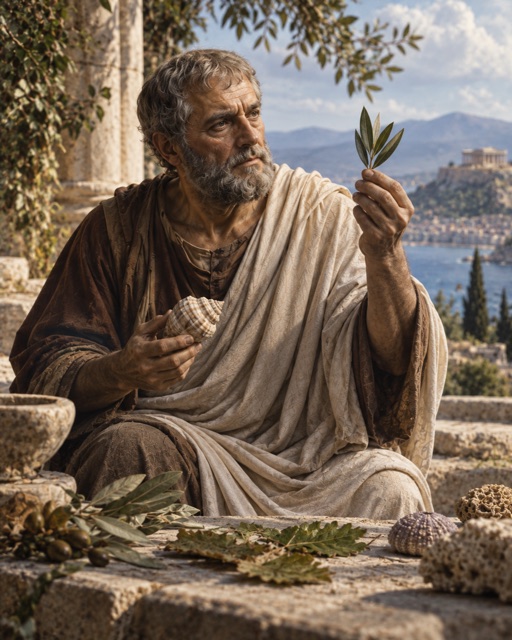
Aristotelianism · Treatise
On the Soul
by Aristotle · The Architect of Causes · Classical Greece, 384-322 BC
Aristotle investigates soul as the actuality of a living body, moving through nutrition, perception, imagination, intellect, desire, and animal motion.
- Brutal
- ~2 hr 15 min read
- 10 chapter guides
- Public domain
Start reading · Read the Book I, Chapter 1 guide free
Before the text
Editor's Prelude
What Makes a Body Alive
Aristotle studied in Plato's Academy before founding his own school in Athens. In On the Soul, the question that joins his inquiries into living things is what it means for a body to be alive. The Greek word translated as soul embraces more than a person's inner life: plants nourish themselves and grow, animals perceive and pursue what they need, and human beings also reason. An account of soul must explain both what these lives share and what distinguishes them.
The examples are often familiar: a sleeping person who still possesses knowledge, an eye that can see, wax receiving the impression of a seal, an animal moving towards food. Through them Aristotle distinguishes a capacity from its exercise and the material of a living body from the organization that enables its activities. A plant's growth and a person's thought belong within the same investigation, though they call for different explanations.
This is a compact philosophical inquiry, full of objections, provisional answers and distinctions that are tested again in new settings. Aristotle argues with earlier thinkers and asks whether their accounts explain the things living beings actually do. The relation of thought to the body remains especially difficult. R. D. Hicks's translation preserves that difficulty alongside Aristotle's efforts to describe sensation, imagination and desire as activities of embodied life.
The opening pages
Book I, Chapter 1
DE ANIMA
Book I
Chapter 1
Cognition is in our eyes a thing of beauty and worth, and this is true of one cognition more than another, either because it is exact or because it relates to more important and remarkable objects. On both these grounds we may with good reason claim a high place for the enquiry concerning the soul. It would seem, too, that an acquaintance with the subject contributes greatly to the whole domain of truth and, more particularly, to the study of nature, the soul being virtually the principle of all animal life. Our aim is to discover and ascertain the nature and essence of soul and, in the next place, all the accidents belonging to it; of which some are thought to be attributes peculiar to the soul itself, while others, it is held, belong to the animal also, but owe their existence to the soul. But everywhere and in every way it is extremely difficult to arrive at any trustworthy conclusion on the subject. It is the same here as in many other enquiries. What we have to investigate is the essential nature of things and the What. It might therefore be thought that there is a single procedure applicable to all the objects whose essential nature we wish to discover, as demonstration is applicable to the properties which go along with them: in that case we should have to enquire what this procedure is. If, however, there is no single procedure common to all sciences for defining the What, our task becomes still more difficult, as it will then be necessary to settle in each particular case the method to be pursued. Further, even if it be evident that it consists in demonstration of some sort or division or some other procedure, there is still room for much perplexity and error, when we ask from what premisses our enquiry should start, for there are different premisses for different sciences; for the science of numbers, for example, and plane geometry.
The first thing necessary is no doubt to determine under which of the summa genera soul comes and what it is; I mean, whether it is a particular thing, i.e. substance, or is quality or is quantity, or falls under any other of the categories already determined. We must further ask whether it is amongst things potentially existent or is rather a sort of actuality, the distinction being all-important. Again, we must consider whether it is divisible or indivisible; whether, again, all and every soul is homogeneous or not; and, if not, whether the difference between the various souls is a difference of species or a difference of genus: for at present discussions and investigations about soul would appear to be restricted to the human soul. We must take care not to overlook the question whether there is a single definition of soul answering to a single definition of animal; or whether there is a different definition for each separate soul, as for horse and dog, man and god: animal, as the universal, being regarded either as non-existent or, if existent, as logically posterior. This is a question which might equally be raised in regard to any other common predicate. Further, on the assumption that there are not several souls, but merely several different parts in the same soul, it is a question whether we should begin by investigating soul as a whole or its several parts. …
Chapter guides · 10
Book I, Chapter 1
What Kind of Inquiry Is This?
Aristotle begins by asking how soul can be defined and how its activities belong to a living body.
A definition needs a method
The treatise opens by ranking knowledge of soul highly, then immediately exposes a methodological difficulty: definition, demonstration, division, and the study of attributes cannot simply be assumed to work here as they do elsewhere.
The whole and its powers
An account of soul must decide whether it concerns one thing common to all living beings or different kinds of soul, and whether the whole or its parts should be studied first. Aristotle also asks whether understanding a power requires first understanding its activity and its object. Definition and the observable attributes of a thing must help explain one another.
Anger has a body
Whether anything the soul does or undergoes belongs to it apart from the body remains a question, with thought the likeliest exception. Anger supplies a concrete test. A dialectician would define it as a desire for retaliation; a natural philosopher describes a bodily process, heat about the heart. As with a house, the full account includes both the form and the material it is realised in. Aristotle then sorts the inquirers: the natural philosopher studies the properties of a given kind of body, a craftsman or a mathematician deals with others, and the first philosopher studies what exists separately. Returning to his point, he ends: the soul's affections, such as anger and fear, cannot be separated from the animal's body, the way a line or a surface can be separated in thought.
Book I, Chapter 5
What Holds the Living Thing Together?
The final chapter of Book I tests whether a mixture of elements can explain knowledge, life and the unity of soul.
Elements do not explain compounds
The claim that like knows like makes soul a mixture of the elements it knows. Aristotle objects that knowing the ingredients does not explain knowing their proportions or the compounds they form. It also fails to explain why some living beings have nutrition without sensation or thought.
The source of unity
If soul consists of parts, something must make them one. Aristotle asks what that unifying principle could be, since soul itself is supposed to hold the body together. Dividing the explanation among separate parts simply raises the question again.
Life in divided organisms
Plants and some divided animals continue living for a time. Aristotle takes their persistence as evidence that the relevant powers have not been neatly allotted to separate bodily pieces. Nutrition is common to living things; perception and the other powers are distributed less widely. These differences are conditions an account of soul must explain.
Book II, Chapter 1
A Living Body and Its Powers
Soul is defined as the first actuality of an organized natural body capable of life.
Book II, Chapter 4
Nourishment and the Continuance of Life
Aristotle examines nutrition and reproduction as the most widely shared living powers.
Book II, Chapter 5
A Capacity Comes into Use
Sensation requires a distinction between acquiring a power, possessing it and exercising it.
Book II, Chapter 12
The Seal and the Wax
The account of the senses ends by distinguishing receiving a sensible form from receiving its matter.
Book III, Chapter 3
An Appearance Is Not a Belief
Aristotle distinguishes imagination from sensing, knowing and holding an opinion.
Book III, Chapter 5
Intellect as Capacity and Activity
The brief chapter distinguishes an intellect that becomes all things from one that makes them actual.
Book III, Chapter 10
What Moves an Animal?
Practical thought and desire direct movement towards an end that appears good.
Book III, Chapter 13
The Necessity of Touch
Aristotle ends by distinguishing the sense necessary for animal life from senses that serve its well-being.
Questions readers ask
- How long does it take to read On the Soul?
- About 2 hr 15 min in total.
- How difficult is On the Soul?
- Brutal. A mid-length treatise; about 2 hours of reading.
- Which translation is this?
- The R. D. Hicks translation from the Ancient Greek. The text follows Aristotle De Anima: With Translation, Introduction and Notes (Cambridge: at the University Press, 1907).
- Can I read On the Soul for free?
- On the Soul is part of Nexus Premium, so reading it needs an account and a Premium subscription. The opening above and two chapter guides on this page are free to read.
- How many chapter guides are there?
- 10 chapter guides, written by the Nexus editors. Two open in full here; the rest show their opening line.
About Aristotle
Aristotle studied at Plato's Academy, tutored the young Alexander the Great, and founded his own school in Athens. His work ranged across logic, ethics, politics, biology, rhetoric, and metaphysics, creating systems that shaped scholarship for centuries.
“What is this thing for?”
Aristotle becomes the operating system for logic, ethics, biology, politics, and medieval scholastic thought.
Source text: public domain. Chapter guides: original Nexus writing. On the Soul is part of The Nexus Archive, guided Quests through the great works.