 The Nexus Archive
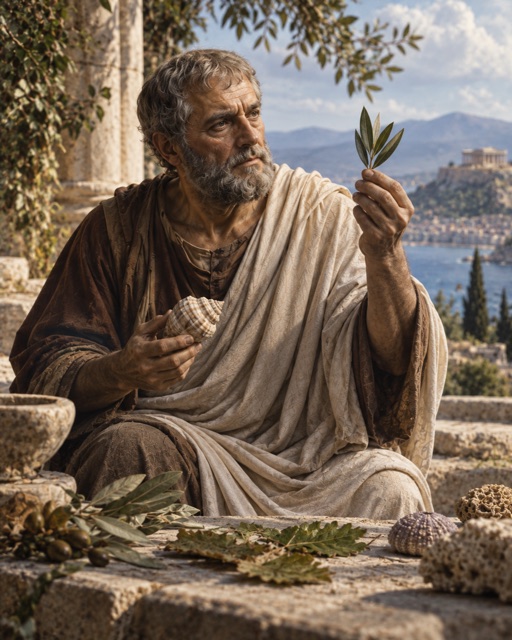
Aristotelianism · Treatise
Nicomachean Ethics
by Aristotle · The Architect of Causes · Classical Greece, 384-322 BC
An investigation of virtue, friendship, judgment, and human flourishing.
- Advanced
- c. 340 BCE
- ~6 hr 15 min read
- 38 chapter guides
- Public domain
Start reading · Read the Translator's Preface guide free
Before the text
Editor's Prelude
A Life Made by Its Actions
Aristotle spent nearly twenty years in Plato's Academy before eventually establishing his own school, the Lyceum, in Athens. In the fourth century BCE, philosophy could concern the ordering of a city as directly as the ordering of a person's life. The Nicomachean Ethics brings those questions together. Aristotle asks what human beings are trying to achieve through their work, choices and relationships, and what would make a whole life go well.
He speaks as a teacher to people who already have some experience of action and some formation of character. His examples are recognisable: learning a craft, facing danger, giving money, losing an argument, making a friend. Their setting is also historically particular. Citizens, households and enslaved people occupy unequal places in the world he assumes. His accounts of dignity and responsibility sometimes carry those inequalities with them.
The happiness at stake is more than a passing feeling of satisfaction. Aristotle is asking about living and acting well over time, with other people and amid circumstances no one entirely controls. A virtue must become dependable in practice, yet good practice requires judgment about a situation that may never recur in exactly the same form. His prose follows that difficulty: common beliefs are tested, distinctions are revised and a plausible answer may prove inadequate. Knowing what deserves to be done and becoming someone who can do it remain closely connected questions.
The opening pages
Book I: Ends and the Highest Good
Chapter 1
Every art and every inquiry, and similarly every action and pursuit, is thought to aim at some good; and for this reason the good has rightly been declared to be that at which all things aim. But a certain difference is found among ends; some are activities, others are products apart from the activities that produce them. Where there are ends apart from the actions, it is the nature of the products to be better than the activities. Now, as there are many actions, arts, and sciences, their ends also are many; the end of the medical art is health, that of shipbuilding a vessel, that of strategy victory, that of economics wealth. But where such arts fall under a single capacity—as bridle-making and the other arts concerned with the equipment of horses fall under the art of riding, and this and every military action under strategy, in the same way other arts fall under yet others—in all of these the ends of the master arts are to be preferred to all the subordinate ends; for it is for the sake of the former that the latter are pursued. It makes no difference whether the activities themselves are the ends of the actions, or something else apart from the activities, as in the case of the sciences just mentioned.
Chapter 2
If, then, there is some end of the things we do, which we desire for its own sake (everything else being desired for the sake of this), and if we do not choose everything for the sake of something else (for at that rate the process would go on to infinity, so that our desire would be empty and vain), clearly this must be the good and the chief good. Will not the knowledge of it, then, have a great influence on life? Shall we not, like archers who have a mark to aim at, be more likely to hit upon what is right? If so, we must try, in outline at least, to determine what it is, and of which of the sciences or capacities it is the object. It would seem to belong to the most authoritative art and that which is most truly the master art.
And politics appears to be of this nature; for it is this that ordains which of the sciences should be studied in a state, and which each class of citizens should learn and up to what point they should learn them; and we see even the most highly esteemed of capacities to fall under this, e.g. strategy, economics, rhetoric; now, since politics uses the rest of the sciences, and since, again, it legislates as to what we are to do and what we are to abstain from, the end of this science must include those of the others, so that this end must be the good for man. For even if the end is the same for a single man and for a state, that of the state seems at all events something greater and more complete whether to attain or to preserve; though it is worth while to attain the end merely for one man, it is finer and more godlike to attain it for a nation or for city-states.
Read it in a Quest
The birthplace of disciplined questioning, where virtue and justice become life's central tests.
Chapter guides · 38
Translator's Preface
Words That Do More Than One Job
Ross explains why Aristotle's Greek cannot always keep the same English equivalent.
The text behind the translation
Ross bases his translation on Bywater's Greek text, recording departures where he adopts a different reading. His preface identifies a particular textual judgment behind the English, rather than presenting the translation as a transparent copy.
A vocabulary still taking shape
Some words are passing from ordinary speech into philosophical use. Ross therefore allows their English equivalents to vary with the argument. A familiar word may carry a more exact meaning here, while a technical term may still retain something of everyday life.
Book I: Ends and the Highest Good
The Chain of Human Aims
Medicine seeks health and strategy seeks victory. Aristotle asks what gives all these pursuits their direction.
An end beyond another end
Aristotle begins with ordinary aiming: arts, choices, and public life all reach toward some good. Some activities serve further purposes; he asks whether there is a highest good that gives the rest their direction. Politics has authority over the others because it orders education and action within the city.
The limits of precision
People agree to call the highest good happiness but disagree over its substance. Pleasure, honour and wealth each leave difficulties. Since human action varies, the inquiry cannot promise the certainty of mathematics. Its intended hearer needs experience and good habits: knowledge alone will not help someone whose desires govern every choice.
Book I: The Human Function
The Function Argument
Aristotle looks for the human good in excellent rational activity, after questioning a single universal Good.
Book I: Fortune, Praise, and the Soul
Happiness Across a Whole Life
Excellent activity gives a life stability, but serious misfortune still matters.
Book II: Habit and Character
Virtue Begins in Practice
Repeated action forms character, but repetition can form bad habits as readily as good ones.
Book II: Defining Moral Virtue
Virtue Chooses the Mean
The right response depends on the person and circumstances, not an arithmetic midpoint.
Book II: The Virtue Table and the Hard Mean
The Mean Is Hard to Hit
Examples give the mean substance, while particular cases still require judgment.
Book III: Voluntary Action and Choice
When an Action Belongs to Us
Force, ignorance and deliberation help distinguish actions for which an agent can be held responsible.
Book III: Wish and Responsibility
How Character Becomes Our Responsibility
Aristotle traces settled dispositions back to actions, while admitting that a formed character is hard to change.
Book III: Courage
Courage Faces the Right Fear
The brave person endures danger for the sake of what is noble, even when endurance is painful.
Book III: Temperance
Temperance Trains Desire
Temperance concerns bodily appetites whose pleasures can come into conflict with reason.
Book IV: Liberality and Money
Giving and Taking Well
Liberality concerns the use of money, especially giving for the right purpose.
Book IV: Magnificence and Greatness of Soul
Great Expenditure and Great Claims
Magnificence concerns spending on a large scale; greatness of soul concerns deserving and claiming great honour.
Book IV: Honor, Anger, and Friendliness
Anger and Social Balance
Honour, anger and pleasant company each require a response that fits the situation.
Book IV: Truth, Wit, and Shame
Truth, Wit and Shame
Conversation has its virtues; shame is a different kind of response.
Book V: Justice as Lawfulness and Fairness
Justice as Whole Virtue Toward Others
Lawfulness and fairness name related but distinct senses of justice.
Book V: Distribution, Correction, and Exchange
Justice Measures Unequal Things
Distribution, correction and exchange require different forms of equality.
Book V: Political Justice and Voluntary Action
Justice Within a Political Order
Citizenship, changing laws and voluntary action complicate the account of a just act.
Book V: Equity and Self-Injustice
Equity and the Limits of a General Law
A just judgment may need to correct a rule that cannot anticipate every case.
Book VI: Kinds of Knowledge
Many Ways to Know
Truth about necessary things differs from the judgment needed for making and acting.
Book VI: Practical Wisdom and Understanding
Judgment That Reaches the Particular
Political wisdom, good deliberation and understanding depend on experience as well as general knowledge.
Book VI: Wisdom and Virtue Together
Virtue and Wisdom Need Each Other
A correct end and sound practical judgment must work together.
Book VII: Incontinence and Knowledge
The Puzzle of Weakness
How can a person act against what he knows to be better?
Book VII: Appetite, Anger, and Endurance
Different Failures of Self-Rule
Appetite, anger, pain and unusual desires do not all produce the same kind of failure.
Book VII: Continence and Weakness
Self-Control and the Character Behind It
Holding to a decision is valuable only when the decision deserves to be held.
Book VII: Pleasure and the Good
Pleasure and the Good
Arguments against pleasure must distinguish its kinds and its relation to activity.
Book VIII: Kinds of Friendship
Why Friendship Belongs in Ethics
People need friends in prosperity as well as adversity, and they love them for different reasons.
Book VIII: Unequal Friendships and Community
Equality Within Unequal Friendships
Friendship can join people of unequal standing, but its claims must reflect the relationship.
Book VIII: Political and Family Friendship
Friendship in Households and Cities
Forms of authority change what affection and justice can mean between people.
Book VIII: Friendship, Claims, and Complaint
Friendship, Claims and Complaint
Disputes arise when friends value the same exchange by different standards.
Book IX: Claims and Broken Friendships
When Friendships Strain or Break
What friends owe depends on the terms, history and purpose of the relationship.
Book IX: Self-Love and Concord
A Friend as Another Self
Friendship, goodwill and civic concord depend on different ways of wishing and acting well.
Book IX: Benefactors, Friends, and Shared Life
Why a Happy Person Still Needs Friends
Benefaction, noble self-love and shared activity connect friendship to a flourishing life.
Book IX: The Need for Companionship
How Many Friends Can a Life Hold?
Intimate friendship needs time, while prosperity and misfortune give friends different occasions to be present.
Book X: Pleasure Reconsidered
Pleasure Gets a Final Hearing
Aristotle weighs arguments about pleasure against both their reasoning and the facts of life.
Book X: Pleasure, Activity, and Happiness
Pleasure Completes Activity
Pleasure strengthens the activity to which it belongs; happiness cannot consist simply in amusement.
Book X: Contemplation and the Best Life
The Highest Human Activity
Aristotle gives contemplation the highest place while preserving the needs and responsibilities of human life.
Book X: Education, Law, and Politics
Education, Law and Political Judgment
Knowing about virtue is insufficient unless character and conduct can be formed.
Questions readers ask
- How long does it take to read Nicomachean Ethics?
- About 6 hr 15 min in total.
- How difficult is Nicomachean Ethics?
- Advanced. A long treatise; about 6 hours of reading.
- Can I read Nicomachean Ethics for free?
- Nicomachean Ethics is part of Nexus Premium, so reading it needs an account and a Premium subscription. The opening above and two chapter guides on this page are free to read.
- How many chapter guides are there?
- 38 chapter guides, written by the Nexus editors. Two open in full here; the rest show their opening line.
About Aristotle
Aristotle studied at Plato's Academy, tutored the young Alexander the Great, and founded his own school in Athens. His work ranged across logic, ethics, politics, biology, rhetoric, and metaphysics, creating systems that shaped scholarship for centuries.
“What is this thing for?”
Aristotle becomes the operating system for logic, ethics, biology, politics, and medieval scholastic thought.
Source text: public domain. Chapter guides: original Nexus writing. Nicomachean Ethics is part of The Nexus Archive, guided Quests through the great works.