 The Nexus Archive
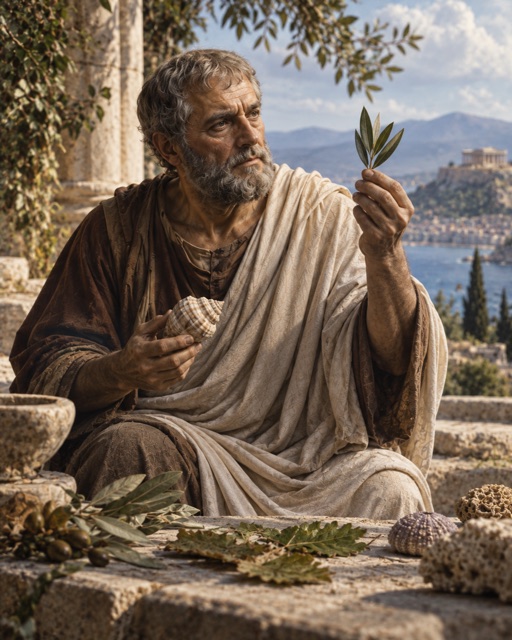
Aristotelianism · Treatise
Metaphysics
by Aristotle · The Architect of Causes · Classical Greece, 384-322 BC
Aristotle's fourteen-book inquiry asks what being, substance, cause, unity, actuality, and first philosophy mean.
- Brutal
- ~8 hr 30 min read
- 10 chapter guides
- Public domain
Start reading · Read the Book little alpha, Chapter 2 guide free
Before the text
Editor's Prelude
The Question behind Every Science
The work later called the Metaphysics is not one smooth book written to a modern outline. Its fourteen books collect investigations that repeatedly approach the same pressure: what must be true before any particular science can explain its own subject?
The questions begin in ordinary acts of knowing. An experienced doctor remembers that a treatment helped a patient; someone who understands the art can explain why it helps a kind of patient. Aristotle gives explanation a higher place, even while admitting that experience can make the better practitioner.
Houses, syllables, and geometrical figures become tests of larger claims. What makes several parts one thing? Can a capacity exist before anyone uses it? Can an explanation keep passing its task to another explanation? Aristotle’s definitions emerge from these arguments. A mistake about a word can become a mistake about what exists.
The opening pages
Book Alpha, Chapter 1
BOOK Α
Chapter 1
All men by nature desire to know. An indication of this is the delight we take in our senses; for even apart from their usefulness they are loved for themselves; and above all others the sense of sight. For not only with a view to action, but even when we are not going to do anything, we prefer seeing (one might say) to everything else. The reason is that this, most of all the senses, makes us know and brings to light many differences between things.
By nature animals are born with the faculty of sensation, and from sensation memory is produced in some of them, though not in others. And therefore the former are more intelligent and apt at learning than those which cannot remember; those which are incapable of hearing sounds are intelligent though they cannot be taught, e.g. the bee, and any other race of animals that may be like it; and those which besides memory have this sense of hearing can be taught.
The animals other than man live by appearances and memories, and have but little of connected experience; but the human race lives also by art and reasonings. Now from memory experience is produced in men; for the several memories of the same thing produce finally the capacity for a single experience. And experience seems pretty much like science and art, but really science and art come to men through experience; for ‘experience made art’, as Polus says, ‘but inexperience luck’. Now art arises when from many notions gained by experience one universal judgement about a class of objects is produced. For to have a judgement that when Callias was ill of this disease this did him good, and similarly in the case of Socrates and in many individual cases, is a matter of experience; but to judge that it has done good to all persons of a certain constitution, marked off in one class, when they were ill of this disease, e.g. to phlegmatic or bilious people when burning with fever,—this is a matter of art.
With a view to action experience seems in no respect inferior to art, and men of experience succeed even better than those who have theory without experience. (The reason is that experience is knowledge of individuals, art of universals, and actions and productions are all concerned with the individual; for the physician does not cure man, except in an incidental way, but Callias or Socrates or some other called by some such individual name, who happens to be a man. If, then, a man has the theory without the experience, and recognizes the universal but does not know the individual included in this, he will often fail to cure; for it is the individual that is to be cured.) But yet we think that knowledge and understanding belong to art rather than to experience, and we suppose artists to be wiser than men of experience (which implies that Wisdom depends in all cases rather on knowledge); and this because the former know the cause, but the latter do not. For men of experience know that the thing is so, but do not know why, while the others know the ‘why’ and the cause. …
Chapter guides · 10
Book little alpha, Chapter 2
Wisdom Seeks the First Causes
An explanation needs a first cause that explains the rest. Aristotle argues that endless chains of causes or definitions would make knowledge impossible.
A chain of causes needs a starting point
If every cause were only an intermediate dependent on something prior, there would be no first cause to explain the series. Aristotle applies this problem to matter and to sources of movement.
A purpose must reach an end
Walking may serve health, and health may serve happiness. If every purpose served another without limit, there would be no final aim. Aristotle argues that purposeful action requires such a limit.
Knowledge requires definite terms
Definitions must reach terms that need no further analysis. The kinds of cause must also be limited in number. Otherwise, Aristotle concludes, a finite act of learning could never grasp them.
Book Gamma, Chapter 6
Appearances Need Their Conditions
Conflicting appearances can come from different senses or conditions. Aristotle argues that these differences do not make contradictory claims true in the same respect at the same time.
Proof depends on a starting point
Demanding proof of everything would remove the principles from which proof begins. Aristotle answers those who seek a demonstration even of these starting points.
Reports must keep their circumstances
Something may look like honey without tasting like it. Crossed fingers can feel two objects where sight shows one. Aristotle separates such reports by sense, time, and condition.
Contrary qualities also need qualification
Things can come to be independently of anyone’s opinion, so Aristotle rejects making everything relative to opinion. He closes by applying the same rule to contrary qualities: they cannot belong together to the same subject in the same respect.
Book Delta, Chapter 12
Potency Names Several Kinds of Ability
Potency is a capacity to cause or undergo change. Aristotle distinguishes several kinds of power, then separates them from the wider meaning of possible.
Book Delta, Chapter 25
A Part Depends on the Whole in Question
Calling something a part can describe different relationships. A share of a quantity, a division of a class, and a term in a definition belong to wholes in different ways.
Book Zeta, Chapter 5
Some Definitions Already Include Their Subject
Snubness already refers to a nose of a certain shape. Aristotle uses this example to test definitions that must name the subject as well as its quality.
Book Eta, Chapter 1
Matter Underlies Sensible Change
Aristotle returns to the physical things generally accepted as substances. Matter, form, and their combination help explain what persists through change.
Book Theta, Chapter 9
Actuality Matters to Value and Knowledge
Being healthy is better than merely being able to be healthy. Aristotle then uses geometrical construction to show how activity can make a possible discovery clear.
Book Kappa, Chapter 2
First Principles Raise Problems of Their Own
Aristotle tests what a first principle could be. The search raises difficulties about individuality, permanence, and the possibility of knowledge.
Book Lambda, Chapter 4
Different Things Have Similar Kinds of Cause
Different things can have causes that play matching roles. Aristotle calls their principles the same by analogy, while keeping their actual components and immediate causes distinct.
Book Mu, Chapter 7
Counting Tests the Theory of Ideal Numbers
Aristotle tests whether numbers could be separate Forms, each unique in kind. His test is whether their units can still be combined in ordinary counting.
Questions readers ask
- How long does it take to read Metaphysics?
- About 8 hr 30 min in total.
- How difficult is Metaphysics?
- Brutal. A long treatise; about 8 hours of reading.
- Which translation is this?
- The W. D. Ross translation from the Ancient Greek. The text follows The Works of Aristotle Translated into English, Volume VIII: Metaphysica, Second Edition (Oxford: Clarendon Press, 1928).
- Can I read Metaphysics for free?
- Metaphysics is part of Nexus Premium, so reading it needs an account and a Premium subscription. The opening above and two chapter guides on this page are free to read.
- How many chapter guides are there?
- 10 chapter guides, written by the Nexus editors. Two open in full here; the rest show their opening line.
About Aristotle
Aristotle studied at Plato's Academy, tutored the young Alexander the Great, and founded his own school in Athens. His work ranged across logic, ethics, politics, biology, rhetoric, and metaphysics, creating systems that shaped scholarship for centuries.
“What is this thing for?”
Aristotle becomes the operating system for logic, ethics, biology, politics, and medieval scholastic thought.
Source text: public domain. Chapter guides: original Nexus writing. Metaphysics is part of The Nexus Archive, guided Quests through the great works.