 The Nexus Archive
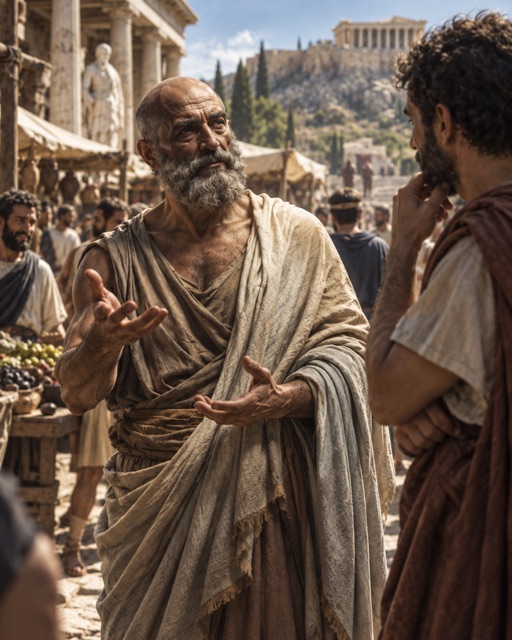
Greek Philosophy · Play
The Clouds
by Aristophanes
Featuring Socrates
Aristophanes' complete comedy presents a hostile Athenian caricature of Socrates, useful as evidence of his public image rather than his teaching.
- Advanced
- ~1 hr 15 min read
- 2 chapter guides
- Public domain
Start reading · Read the Dramatis Personæ and The Argument guide free
Before the text
Editor's Prelude
Socrates under the Comic Mask
In The Clouds, a father lies awake counting debts while his son dreams of horses. Strepsiades wants relief from the bills, and the school of Socrates seems to promise something better than money: an argument that can make a creditor lose his case. His hunger for learning begins with a wish to escape what he owes.
Aristophanes makes a living Athenian philosopher into a comic figure, surrounded by fantastic experiments and lessons in verbal trickery. The portrait brings anxieties about new education, natural inquiry, courtroom argument, fathers and sons, and the authority of old gods onto the same stage. It is evidence of a public image, not a record of Socrates' teaching.
The comedy gives the desire to win an uncomfortable familiarity. Strepsiades can recognize an absurdity when it inconveniences him, yet welcome one when it serves his purpose. Around him, arguments become performers, and even the Clouds have voices of their own. Cleverness and judgment are already pulling in different directions.
Chapter guides · 2
Dramatis Personæ and The Argument
A Philosopher among the Players
The cast places Socrates beside a household, a chorus of Clouds and two rival arguments; Hickie's Argument then outlines the comedy.
A comic company
Socrates is one figure in a cast that also names a servant, disciples and a witness. Aristophanes is the credited author; the philosopher is a character.
Arguments with parts to play
The cast list keeps the Greek word logos, meaning argument or speech: a Just Logos and an Unjust Logos are listed as characters, so opposing arguments get parts to play. In the play Hickie calls them the two Causes. Pasias, Amynias, a Witness and Chærephon complete the cast, joining the household, school and chorus in the comedy.
Hickie's Argument
The translator's Argument tells the plot in brief. Strepsiades, a farmer ruined by his son's extravagance, hopes Socrates' new art of reasoning will help him escape his creditors. He proves a hopeless pupil, so his son Phidippides goes instead, then beats his father and argues that the beating is right; the old man sees the wickedness of the new teaching and sets fire to the school. Hickie adds that the play lost when it was first staged in 423 BC, and he closes with Schlegel's report that Plato sent the Clouds to Dionysius the elder as a guide to the state of things at Athens.
The Play — Part 2
Winning against His Father
Strepsiades has used clever argument to reject his debts; his son now claims the same freedom from obligation.
Questions readers ask
- How long does it take to read The Clouds?
- About 1 hr 15 min in total.
- How difficult is The Clouds?
- Advanced. A mid-length play; about an hour of reading.
- Can I read The Clouds for free?
- Yes. The Clouds is free to read with a Nexus account.
- How many chapter guides are there?
- 2 chapter guides, written by the Nexus editors. One opens in full here; the rest show their opening line.
About Socrates
Socrates spent his life questioning citizens in the public spaces of Athens. He wrote nothing himself; what survives comes mainly through Plato and other students. Convicted of impiety and corrupting the young, he refused escape and died by drinking hemlock.
“What do you mean by that?”
Socrates makes thinking dangerous. He shows that a civilization can be powerful, cultured, and still unable to answer basic questions about justice, virtue, and the good life.
Source text: public domain. Chapter guides: original Nexus writing. The Clouds is part of The Nexus Archive, guided Quests through the great works.