 The Nexus Archive
Constitutional Republicanism · Essay
Thoughts on Government
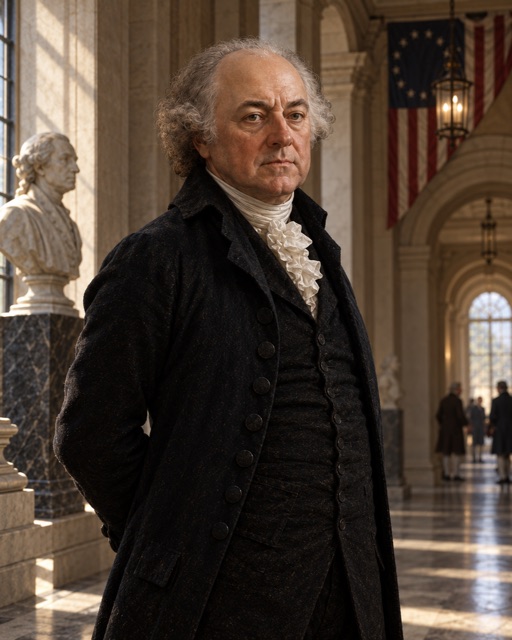
by John Adams · The Honest Pessimist · American Founding, 1735-1826
Adams's compact plan for republican government, balanced powers, annual elections, public education, and constitutional liberty.
- Beginner
- 1776
- ~20 min read
- 3 chapter guides
- Public domain
Start reading · Read the Happiness and Representation guide free
Before the text
Editor's Prelude
Designing Liberty Under Pressure
In 1776 a revolt against royal authority also became a problem of daily government. Someone would have to make laws, command forces and settle disputes while the outcome of the conflict remained uncertain. Adams’s short proposal faces the risk that replacing a king might leave power no less dangerous in new hands.
He wants liberty, but he also knows ambition, vanity, fear, corruption, and the hunger for power are not British inventions. A free people will need more than noble declarations. Representation and divided authority must work among people who can mistake their own advantage for the public good.
The document moves between principles and provisional arrangements. Its practical questions—who chooses an officer, who can refuse a law, who pays a judge—give political freedom a material form. Alongside them stands a larger hope: that the habits a government encourages can make its people capable of sustaining it.
The opening pages
Happiness and Representation
My dear Sir,—If I was equal to the task of forming a plan for the government of a colony, I should be flattered with your request, and very happy to comply with it; because, as the divine science of politics is the science of social happiness, and the blessings of society depend entirely on the constitutions of government, which are generally institutions that last for many generations, there can be no employment more agreeable to a benevolent mind than a research after the best.
Pope flattered tyrants too much when he said,
- “For forms of government let fools contest,
- That which is best administered is best.”
Nothing can be more fallacious than this. But poets read history to collect flowers, not fruits; they attend to fanciful images, not the effects of social institutions. Nothing is more certain, from the history of nations and nature of man, than that some forms of government are better fitted for being well administered than others.
We ought to consider what is the end of government, before we determine which is the best form. Upon this point all speculative politicians will agree, that the happiness of society is the end of government, as all divines and moral philosophers will agree that the happiness of the individual is the end of man. From this principle it will follow, that the form of government which communicates ease, comfort, security, or, in one word, happiness, to the greatest number of persons, and in the greatest degree, is the best.
All sober inquirers after truth, ancient and modern, pagan and Christian, have declared that the happiness of man, as well as his dignity, consists in virtue. Confucius, Zoroaster, Socrates, Mahomet, not to mention authorities really sacred, have agreed in this.
If there is a form of government, then, whose principle and foundation is virtue, will not every sober man acknowledge it better calculated to promote the general happiness than any other form?
Fear is the foundation of most governments; but it is so sordid and brutal a passion, and renders men in whose breasts it predominates so stupid and miserable, that Americans will not be likely to approve of any political institution which is founded on it.
Honor is truly sacred, but holds a lower rank in the scale of moral excellence than virtue. Indeed, the former is but a part of the latter, and consequently has not equal pretensions to support a frame of government productive of human happiness.
Read it in a Quest
A revolutionary test of liberty, power, union, and the price of self-rule.
Chapter guides · 3
Happiness and Representation
The End Is Happiness
Adams begins by asking what government is for before designing its machinery.
Public happiness is the end
Adams rejects the easy claim that forms of government do not matter. If the end of government is public happiness, then the structure of government matters because some forms are better built to protect that happiness than others.
A portrait in miniature
Adams wants a representative assembly to think, feel and act like the people, with equal interests equally represented. This is not simply a demand for efficient administration. A republic’s authority depends on impartial laws and on the way representatives are chosen.
An urgent, imperfect beginning
Adams warns against corrupt and partial elections but postpones detailed reform to quieter times. For the present he favours familiar electoral practices. His commitment to a just representation therefore sits beside a practical concession to the crisis in which governments must be formed.
Checks Against Power
Power Must Check Power
Adams argues that a free people need divided institutions, not one unchecked assembly.
An assembly can become a master
Adams lists the dangers of a single assembly: passion, self-interest, ambition, weak execution, poor judging, and arbitrary rule. His answer is a layered government with a representative house, a council, an executive, annual elections, and offices that can restrain each other.
The council between two powers
A council chosen by the representative assembly is to mediate between it and the executive. Adams gives both council and governor a negative voice in legislation. Separating offices alone would leave rival powers encroaching on one another; each must have means to check the others.
Frequent elections and experiment
Adams strongly favours annual elections as a school of humility for officeholders, yet allows later experience to change appointment methods and terms. He also considers rotation where enough qualified people are available. The proposal combines safeguards with room for revision, rather than fixing every office in one permanent form. His closing proposals give the governor command of the militia and armies, with pardons shared with the council. Officers would be appointed by the governor with the council’s consent or, for a more popular government, chosen by ballot of the two houses. County freeholders would choose sheriffs, deed registers and clerks. Every officer would receive a commission under the governor’s hand and the colony’s seal.
Judges, Education, and Union
A House For Freedom
Adams closes by joining independent courts, public education, and union to the survival of liberty.
Questions readers ask
- How long does it take to read Thoughts on Government?
- About 20 min in total.
- How difficult is Thoughts on Government?
- Beginner. A short essay; about 20 minutes of reading.
- Can I read Thoughts on Government for free?
- Yes. Thoughts on Government is free to read with a Nexus account.
- How many chapter guides are there?
- 3 chapter guides, written by the Nexus editors. Two open in full here; the rest show their opening line.
About John Adams
John Adams was a revolutionary leader, diplomat, constitutional thinker, and the second president of the United States. His writings stress law, balance, virtue, ambition, and the dangers that threaten republican government from within.
“What kind of people can actually keep a republic?”
Adams gives Nexus the harder, less romantic side of the American founding: liberty requires structure, restraint, and character.
Source text: public domain. Chapter guides: original Nexus writing. Thoughts on Government is part of The Nexus Archive, guided Quests through the great works.